Monday, June 11, 2012

Troubles On The Sabbath


23 One Sabbath Jesus was going through the grainfields, and as his disciples walked along, they began to pick some heads of grain. 24 The Pharisees said to him, “Look, why are they doing what is unlawful on the Sabbath?”
25 He answered, “Have you never read what David did when he and his companions were hungry and in need? 26 In the days of Abiathar the high priest, he entered the house of God and ate the consecrated bread, which is lawful only for priests to eat. And he also gave some to his companions.”
27 Then he said to them, “The Sabbath was made for man, not man for the Sabbath. 28 So the Son of Man is Lord even of the Sabbath.”
Another time Jesus went into the synagogue, and a man with a shriveled hand was there. Some of them were looking for a reason to accuse Jesus, so they watched him closely to see if he would heal him on the Sabbath.Jesus said to the man with the shriveled hand, “Stand up in front of everyone.”
Then Jesus asked them, “Which is lawful on the Sabbath: to do good or to do evil, to save life or to kill?” But they remained silent.
He looked around at them in anger and, deeply distressed at their stubborn hearts, said to the man, “Stretch out your hand.” He stretched it out, and his hand was completely restored. Then the Pharisees went out and began to plot with the Herodians how they might kill Jesus.

This series of controversies about the Sabbath have little meaning in our modern culture.  We live in a world of twenty-four hours a day seven days a week access and expectation.  It seems odd to us to set aside a whole day to eschew labor of any kind, and Jesus actions strike us not so much as a scandal but as an obvious and practical use of his time.

The tradition of Sabbath goes back to the Old Testament and is one of the Ten Commandments.  The Hebrews traced the practice to the mists of creation.  Since God rested on the seventh day, people ought to follow the same practice.  The decalogue contains no listing of relative punishments or significance so one must assume that do not kill and remember the Sabbath are of equal importance.  So, when Jesus violates their interpretation of Sabbath keeping, it is seen as important affront.  

The first incident is when Jesus and his disciples are walking on Sabbath through the grain fields.  As they go, they are making a snack of some of the wheat as they pass.  First the Pharisees have said things against Jesus in their hearts, but Jesus heard and answered them.  Then the Pharisees ask Jesus disciples why their master behaves so inappropriately, but Jesus heard and answers them.  Finally, the Pharisees directly address Jesus with their complaint since he seems to know what they are saying whether they tell him or not.

"Why do you let them break the Sabbath?"  The Sabbath as practiced by the Jews of Jesus day was a very regimented affair with clearly defined rules.  The disciples may not only have been breaking the rule with regard to work (they were technically harvesting the grain), but also the one that allowed only a certain amount of walking unless it involved going to worship.
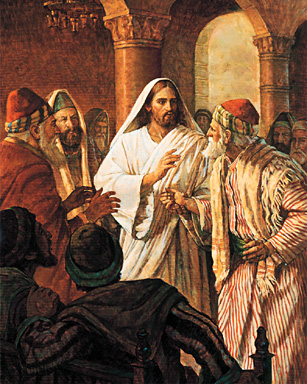
Jesus responds in a language that the Pharisees will understand.  He uses a story from what is now the Old Testament.  David, in a pinch, feeds his soldiers with the bread from the temple.  This may seem to us a bit strange for an example as it never refers to the Sabbath but is instead about sacred bread.  For the teachers of the law, though, this would have been a reasonable argument from tradition

And Jesus asks the rhetorical question that closes the conflict.  Certainly God made the Sabbath for people and not the other way around.  When Sabbath traditions cease to be helpful to people they ought to be disregarded.

Jesus doesn't reject the concept of Sabbath, but the rules that had been instituted to protect it from violation.  The next incident will show just how trivial and detrimental the Sabbath rules had become.

Jesus heals the man with a shriveled hand.  The Pharisees consider this work and another Sabbath violation.  If the man had been facing death, Jesus could have healed him, but since his disability could wait to be healed until the next day with no risk of death it had to be delayed.  As far as the rules were concerned, the man would just have to continue to suffer.

We are told that even before Jesus acts they are watching and when Jesus heals the man, he does so with anger at them.  This is the second angry healing in Mark, the first one when the man with leprosy comes and begs healing.  We don't often consider anger and healing together, but in these two cases it is the common motif.  Jesus wants to heal, but others want him to heal for their own reasons and this exposes them to Jesus' wrath.

And so the ones who are so concerned with keeping the Sabbath commandment immediately turn their thoughts to breaking one themselves.


Monday, June 4, 2012

Sinner and Tax Collectors


13 Once again Jesus went out beside the lake. A large crowd came to him, and he began to teach them. 14 As he walked along, he saw Levi son of Alphaeus sitting at the tax collector’s booth. “Follow me,” Jesus told him, and Levi got up and followed him.
15 While Jesus was having dinner at Levi’s house, many tax collectors and sinners were eating with him and his disciples, for there were many who followed him. 16 When the teachers of the law who were Pharisees saw him eating with the sinners and tax collectors, they asked his disciples: “Why does he eat with tax collectors and sinners?”
17 On hearing this, Jesus said to them, “It is not the healthy who need a doctor, but the sick. I have not come to call the righteous, but sinners.”
18 Now John’s disciples and the Pharisees were fasting. Some people came and asked Jesus, “How is it that John’s disciples and the disciples of the Pharisees are fasting, but yours are not?”
19 Jesus answered, “How can the guests of the bridegroom fast while he is with them? They cannot, so long as they have him with them. 20 But the time will come when the bridegroom will be taken from them, and on that day they will fast.
21 “No one sews a patch of unshrunk cloth on an old garment. Otherwise, the new piece will pull away from the old, making the tear worse. 22 And no one pours new wine into old wineskins. Otherwise, the wine will burst the skins, and both the wine and the wineskins will be ruined. No, they pour new wine into new wineskins.”

Leaving the house, Jesus goes to the lakeside.  The crowds that have now become ever present are quick to form.  And Jesus does what Jesus wants to do, he teaches them.

But even while teaching, Jesus can not stay put.  And so as he walks along, he sees Levi.  Just like the earlier accounts of the calling of the fishermen, it is Jesus who comes upon the unsuspecting tax collector who is busy at his work.

And what a work it is.  Tax collectors were held in great contempt by both the Romans and the Jews.  They were given a flat amount of money by Rome that they were to provide.  The Romans saw them as traitors who had turned on their own people.  The Jews liked them even less, as their wages were whatever they could collect beyond the amount determined by Rome.  They were considered to be unscrupulous thieves who used the force of the empire to protect them from the laws that would punish someone who demanded money in any other form of strong-armed robbery.

So tax collectors kept to themselves and enjoyed their riches even as they were rejected by all polite society.  Jesus calling a tax collector would have been a great social faux pax.  His detractors would see this as further proof that Jesus was straying from God's guidance.

The call is made even more interesting because it has no content.  Jesus didn't tell Levi what he was being called to do.  Jesus didn't tell Levi here is a list of all the things you have to believe to be my disciple.  Jesus didn't tell Levi here is a list of all the things you need to give up to be right with God.  It is merely--follow me.  When he does that none of the other things seem that important.

Levi is so thrilled with Jesus accepting him and calling him to follow that he prepares a large banquet in his home.  He invites his friends--who of course are the other tax collectors and ne'er-do-wells.  The crowd is quite large what with Levi's invitees, the disciples and those who are following Jesus.

The Pharisees who are now on Jesus' tail, watching him and hoping to get back at him for embarrassing them when he forgave and healed the paralytic. But they are afraid of Jesus, so instead of addressing him, they confront Jesus disciples.  "Why does he eat with people like this--the unclean and the  outcasts?"

But Jesus who previously heard the muttering of their hearts has no problem overhearing the audible words spoken to his disciples.  "You don't go to the doctor unless something is wrong with you.  I came to sinners not the people who think there is nothing wrong with them."  The Pharisees may have considered this a compliment, but only because they failed to understand that they were sinners just like everyone else.  Jesus came for everyone, but some are like the Pharisees and see themselves as righteous and without the need of forgiveness.

The case against Jesus continues to be built when the disciples both of the Pharisees and of John are involved in religious fasting.  But Jesus' disciples freely eat and drink.  "Why?" he is asked.  And Jesus answers that at a wedding party, people celebrate.  It is only when the bridegroom has gone and the party is over that people return to their normal lives.  But Jesus already knows that he is headed toward the path of sorrow so he tells them there will be a time for fasting later when the bridegroom is taken away.

The passage concludes with a reference to storing wine.  Old wine in old skins and new wine in new.  During the process of fermentation, a wine expands.  New skins expand with the wine but old skins that have already stretched tear and burst.

This remarkable saying indicates that the teaching that Jesus brings will not fit in the religious orthodoxy of the Pharisees, but that their traditions will burst under the new strain of God's teaching and revelation.  It is not only a warning to them, but a warning to us that whenever our doctrine becomes so rigid that their is no room for God to do new work within it that God's work will not be constrained but that our structures will burst trying to contain it. 


Monday, May 28, 2012

Friends


A few days later, when Jesus again entered Capernaum, the people heard that he had come home. They gathered in such large numbers that there was no room left, not even outside the door, and he preached the word to them.Some men came, bringing to him a paralyzed man, carried by four of them. Since they could not get him to Jesus because of the crowd, they made an opening in the roof above Jesus by digging through it and then lowered the mat the man was lying on. When Jesus saw their faith, he said to the paralyzed man, “Son, your sins are forgiven.”
Now some teachers of the law were sitting there, thinking to themselves, “Why does this fellow talk like that? He’s blaspheming! Who can forgive sins but God alone?”
Immediately Jesus knew in his spirit that this was what they were thinking in their hearts, and he said to them, “Why are you thinking these things? Which is easier: to say to this paralyzed man, ‘Your sins are forgiven,’ or to say, ‘Get up, take your mat and walk’? 10 But I want you to know that the Son of Man has authority on earth to forgive sins.”So he said to the man, 11 “I tell you, get up, take your mat and go home.” 12 He got up, took his mat and walked out in full view of them all. This amazed everyone and they praised God, saying, “We have never seen anything like this!”

This story of the healing of the paralytic stands in stark contrast to the one that precedes it.  While the former story may leave the impression that the ministry of healing inconveniences Jesus, this passage reveals a healing that promotes and confirms Jesus' ministry.

Arriving in his home region, the crowd is huge.  Obviously, the man healed from leprosy and any of a number of others whom Jesus had healed and released from demons had been busy spreading the word.  The crowd is huge, and there seems to be no room for anyone to turn around.

They have come to see a miracle--and Jesus preaches the word.  Once again, the conflict between what the crowds want Jesus to do and what Jesus wants to do is central to the story.

But this time, it will be different.  Now, rather than someone coming to Jesus of their own accord, the paralytic man is brought by his friends (we do not and cannot know whether the man on the pallet agreed with the plan).  The four friends encounter the crowd.  The solid wall of people do not deter them.  Realizing that the door is not an option, the engineer in the bunch develops a cunning plan to put a hole in the roof.  While this is not the original context, it reminds me of a funeral procession with pallbearers, the excavation of the grave and the lowering of the body.

The digging is described, but not the reaction in the crowded room where the dust and debris begin to rain down.  Also not shared is the reaction of the owner of the house (would he tell the State Farm agent that it was "Hale" damage?).

The man is lowered from the sky, and it probably isn't significant, but one other time so far in the gospel, something has descended upon Jesus from heaven.  It was the Spirit at his baptism.  Perhaps this is why Jesus is not angry as he is with the man at the end of Chapter 1, because this is a task given to him by God.

And when Jesus saw their faith--their faith?  The faith of the friends or the friends and the man?  The friends have been the only ones digging and that is all that could be seen so far, unless Jesus is using spiritual sight.  There seems to be a larger point made here--that when friends bring the hurting to Jesus, there is salvation.  Our faith can have an impact on the lives of others even when they have no faith of their own.

"Your sins are forgiven." Jesus says to the man.  What an odd thing to say.  Isn't this a healing story?  What does sin have to do with that?  Is the man's sin connected to his condition?  And how could the actions of others lead to the forgiveness of someone else?

These are profound questions that don't seem to be easily answered.  But it does point again to how we misremember this story as a healing story and not a salvation story.  Jesus is preaching repentance and salvation and that is the first gift he offers the man--not healing.

But the controversy that will lead to Jesus' death is already stirring as the religious types converse among themselves about God alone being able to forgive sins.  If Jesus had been content to do what the crowd wanted (healing), it seems likely that the religious authorities would have embraced him.  And while they intend to keep this plotting to themselves, Jesus is aware of their challenge.

"Which is easier?" He asks.  They would likely answer incorrectly that forgiving is easier than healing.  But it is almost certain that for Jesus it is the other way around.  So when Jesus heals for them it is a primary display, while Jesus knows that the primary display is really the gift of forgiveness that leads to salvation.

When he tells the man to get up, it recalls the prior healing as well.  When Jesus pronounces the leper healed he tells him to go to the priests, which the exuberant man fails to do.  But when Jesus heals this man and tells him what he should do, the man obeys.  His faith is revealed to be as strong as his friends who have brought him.  He is a disciple

But the confusion and ambiguity around these stories continues.  The crowd has never seen anything like this.  They probably mean "this" with regard to the healing, but what should amaze them is the power of the forgiveness of sins. They have seen this man's life change for the moment, but more importantly seen it changed for eternity.  This is not a healing story, it is a salvation story.

Monday, May 21, 2012

I Am Willing


Mark 1
40 A man with leprosy came to him and begged him on his knees, “If you are willing, you can make me clean.”
41 Jesus was indignant. He reached out his hand and touched the man. “I am willing,” he said. “Be clean!”42 Immediately the leprosy left him and he was cleansed.
43 Jesus sent him away at once with a strong warning:44 “See that you don’t tell this to anyone. But go, show yourself to the priest and offer the sacrifices that Moses commanded for your cleansing, as a testimony to them.” Instead he went out and began to talk freely, spreading the news. As a result, Jesus could no longer enter a town openly but stayed outside in lonely places. Yet the people still came to him from everywhere.


So what are we to make of this man with leprosy?  My first instinct is to give him credit--he does, after all, come to Jesus.  But then again, maybe that isn't such a good sign after all.  So far in the gospel of Mark, everyone Jesus has come to after his wilderness testing has become a disciple. Jesus goes to Simon, Andrew, James and John and says "Follow me", and they do.  He goes to Simon's Mother-in-law, cures her fever, and she serves him.

But what happens when Jesus is approached by someone of their own accord in Mark? The first person to initiate an encounter with Jesus is the man with the impure spirit who is healed, but he leaves as abruptly as he came.  This work of wonder is followed by crowds seeking Jesus to heal their loved ones and while Jesus does, he also at the first opportunity goes to a solitary place to escape them and pray.  And now this man with leprosy comes to Jesus and begs from his knees for cleansing.  We are prepared, if we have read carefully, for this encounter to not go so well.

"If you are willing, you can make me clean." says this poor man suffering from leprosy, and the Sunday School Jesus we expect says, "I know you're pain.  Here let me heal you."  But Mark's Jesus is not nearly as kind, Jesus is indignant.  "If!" he seems to shout.  Of course, "I am willing"--be clean.  And as quick as that the man with leprosy loses his identifying prepositional phrase and becomes simply a man.

But the story does not end here.  Jesus continues to seem to be perturbed by this former leper, and he sends him on his way with a strong warning.  He is not to tell anyone but to show himself to the priests.  This showing to the religious authorities seems to be important for two purposes.  First, without being pronounced clean the man can not re-enter his community.  But secondarily, showing the priests is a way for Jesus to validate his place as the Christ.

Left now with clear instructions on how he ought to follow Jesus' will, the man refuses.  Jesus has willed him to be clean and now wants him to go to the priests, and the man is quite happy to follow Jesus to healing but as soon as that is accomplished, he turns and goes the other way.

Typically, we would think that spreading the news about Jesus' power is a good thing, but we must remember that Jesus is preaching about salvation and repentance.  This man hasn't stuck around long enough to hear any of that.  He leaves with only part of Jesus' message.  And so while Jesus preaches the "good news", Mark tells us that this former leper leaves to tell the "news."

The result is that Jesus is no longer able to go out in public.  He wanted to preach, but the crowds don't want to listen.  They want Jesus to serve them, not to listen and become disciples.

The passage of course contains a great irony.  Jesus works to restore the man with leprosy to the community.  And the man's witness essentially marginalizes Jesus by forcing him to stay in solitary places to avoid the clamoring crowd, denying Jesus a place in the very community he came to save.

Sunday, May 13, 2012

The One With Authority


Mark
21 They went to Capernaum, and when the Sabbath came, Jesus went into the synagogue and began to teach. 22 The people were amazed at his teaching, because he taught them as one who had authority, not as the teachers of the law. 23 Just then a man in their synagogue who was possessed by an impure spirit cried out, 24 “What do you want with us, Jesus of Nazareth? Have you come to destroy us? I know who you are—the Holy One of God!”
25 “Be quiet!” said Jesus sternly. “Come out of him!” 26 The impure spirit shook the man violently and came out of him with a shriek.
27 The people were all so amazed that they asked each other, “What is this? A new teaching—and with authority! He even gives orders to impure spirits and they obey him.” 28 News about him spread quickly over the whole region of Galilee.
29 As soon as they left the synagogue, they went with James and John to the home of Simon and Andrew. 30 Simon’s mother-in-law was in bed with a fever, and they immediately told Jesus about her. 31 So he went to her, took her hand and helped her up. The fever left her and she began to wait on them.
32 That evening after sunset the people brought to Jesus all the sick and demon-possessed. 33 The whole town gathered at the door, 34 and Jesus healed many who had various diseases. He also drove out many demons, but he would not let the demons speak because they knew who he was.
35 Very early in the morning, while it was still dark, Jesus got up, left the house and went off to a solitary place, where he prayed. 36 Simon and his companions went to look for him, 37 and when they found him, they exclaimed: “Everyone is looking for you!”
38 Jesus replied, “Let us go somewhere else—to the nearby villages—so I can preach there also. That is why I have come.” 39 So he traveled throughout Galilee, preaching in their synagogues and driving out demons.


With his baptism and temptation in the wilderness complete and four new found disciples in tow, Jesus begins his ministry proper in this week's passage.  And on the Sabbath, as any observant Jew would do, Jesus goes to the synagogue.

I wonder how he was received?  In terms of a seminary degree or rigorous training, as far as we know, Jesus was lacking.  So he shows up at the synagogue and starts teaching never having earned tenure or any other sort of accreditation.

And I can just imagine that all the people who had put in their time being trained (people like me by the way) watched this man show up and start speaking and wished he would just stop.  And then people start paying attention--the same people who had used to pay attention to them--and you can almost sense their boiling blood.  They had given themselves in long hours to these people and now this interloper shows up and like the pied piper starts leading the faithful away.

But the people saw something different.  They saw someone who spoke not by quoting a long list of ancient authorities, but someone who spoke from an authority that was within him.

Things seem to take a better turn for the leaders of the synagogue when the crazy guy on the street corner wandered in.  He was the one that they tried to keep out because he was always such a disruption.  And he did what he always did--shouting, interrupting.  Maybe this would break the strange spell that Jesus seems to have had over the crowd.

The man seems to know quite a lot about this new teacher--his name (Jesus), his home (Nazareth), his task (destroying evil), and most importantly who he was (the Holy One of God).  In case you didn't miss it in verse one or Jesus baptism, Mark wants his readers to know who Jesus is.  What is it about Jesus that makes demons speak the truth and religious leaders want to violate their own laws (thou shalt not kill comes to mind)?

But rather than the distraction that the religious leaders hoped for, this encounter turns into further proof of who Jesus is.  "Come out."  The man shakes and shrieks, and the demon leaves him.  And the people (the anonymous little people of the gospel) come to the conclusion that Jesus should be listened to because:  1.  A new teaching (repent and believe is all that Mark has identified so far of the content)  2.  Authority and 3.  Ability to command evil spirits.

Leaving the synagogue, Jesus goes to Simon and Andrew's house to heal Simon's mother-in-law.  What?!  Simon is (was?) married.  Where is his wife? What does she have to say about Simon following Jesus immediately (without even a text message if Mark is to be believed)? And when she is healed she gets up to serve them, which may in a modern world's sensibilities seem hopelessly outdated, but may also be the first calling of a female disciple.  What is the role of a disciple?  To serve Jesus.  So Jesus heals her and she serves him, how can this be anything other than another "follow me" moment.

It doesn't take long for word to get around and the crowds come to Jesus looking to be healed.  And while Jesus heals some and keeps any more demonic outbursts of his identity unspoken, shortly he is nowhere to be found.

When the disciples finally find him, he has gone off to be by himself.  And we have our first hint that the thing that the people want from Jesus (to be healed) is not what Jesus sees as his primary mission (preaching).  Healing may draw a crowd, but preaching brings repentance and salvation.  The crowd is interested in short-term relief while Jesus is interested in the life that stretches into eternity.  This tension will continue throughout the gospel.

Monday, May 7, 2012

Follow Me


Mark 1
16 As Jesus walked beside the Sea of Galilee, he saw Simon and his brother Andrew casting a net into the lake, for they were fishermen. 17 “Come, follow me,” Jesus said, “and I will send you out to fish for people.” 18 At once they left their nets and followed him.
19 When he had gone a little farther, he saw James son of Zebedee and his brother John in a boat, preparing their nets.20 Without delay he called them, and they left their father Zebedee in the boat with the hired men and followed him.

In the gospel of Mark, Jesus almost always is a moving target.  We find him today walking beside the Sea of Galilee.  Having been baptized and tested, Jesus is ready to begin his ministry.

He sees two fishermen, probably not an unusual sight.  They are busy at their work.  Like many people, they are defined by their job.  They have names of course but nothing more than that and their occupation.  A little like the waiter at the table or the cashier at Wal-mart, the only thing we know about them is their job. Did they define themselves and their worth by their work as many modern people do?  Perhaps they did, because when Jesus tells them to follow, he tells them that they will still be doing the same thing, but with a twist.  They will no longer be taking fish out of water, but people from the dominant culture.  They leave their nets, which seems surprising, given that these were the tools of their trade.  Simon and Andrew, merely at the call of Jesus to follow, give up their security and future.

This raises an ancillary question that is rarely considered.  Why did Jesus have disciples at all?  If Jesus is the son of God, why would he need any help?  And if he did not need disciples, why did he gather these to go with him?  Why not get the "right" people who already had influence and power rather than the vagabond blue collar bunch he ends us with?

With Simon and Andrew in tow, Jesus comes upon James and John.  I don't know the fishing practices of ancient Galilee, but Simon and Andrew seem to be fishing from the shore while James and John are fishing from a boat.  Does this mean that James and John are more successful owning better equipment and having a bigger operation?  It certainly appears that they are a part of a family business as they leave their father and a group of hired hands to follow.

Why did Jesus call these two rather than Zebedee or the other workers?  Did he call them all, but only James and John had the courage to leave?  We can't be sure.  But one thing we can be sure of, almost as soon as he starts, Jesus breaks up families.  This is of course entirely contrary to the modern church's proclamation of family values.  In that culture, Zebedee's sons would have been his retirement policy, he could not have afforded to lose them without losing what he thought would be his social security.  Did he bless their going because he could no longer go himself or did he look angrily at Jesus as he saw the new commitment of his sons was destroying his future?  Jesus is more concerned with gathering followers than keeping families together.

Do you notice that Jesus does not ask the four about their beliefs or lives?  Perhaps as son of God he already knew or more likely, he didn't care.  Jesus calls people not because they are good or can help him, but because as they follow, they will become the people God want them to be.

What does Jesus want?  Follow me.

Sunday, May 6, 2012

Repent and Believe

This morning's sermon focused on the central question:  What does God look like?

Mark answers that question by mimicking stylistically, the announcements of Roman military victory.  The content of his proclamation is quite different.  Rather than a military king, he describes Jesus who lowers himself to be baptized and tested in the wilderness.  God cares so much about us God took human form to be with us.

The "victory" is found in belief and repentance, not swords and shields.

What would God have us do?  Repent and believe.  What does God look like?  Jesus Christ!