Monday, October 15, 2012

Dazzling White


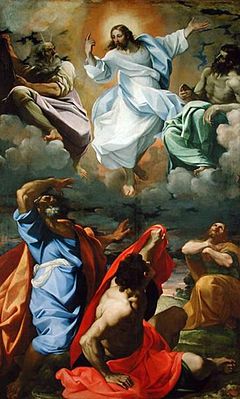
After six days Jesus took Peter, James and John with him and led them up a high mountain, where they were all alone. There he was transfigured before them. His clothes became dazzling white, whiter than anyone in the world could bleach them. And there appeared before them Elijah and Moses, who were talking with Jesus.
Peter said to Jesus, “Rabbi, it is good for us to be here. Let us put up three shelters—one for you, one for Moses and one for Elijah.” (He did not know what to say, they were so frightened.)
Then a cloud appeared and covered them, and a voice came from the cloud: “This is my Son, whom I love. Listen to him!”
Suddenly, when they looked around, they no longer saw anyone with them except Jesus.
As they were coming down the mountain, Jesus gave them orders not to tell anyone what they had seen until the Son of Man had risen from the dead. 10 They kept the matter to themselves, discussing what “rising from the dead” meant.
11 And they asked him, “Why do the teachers of the law say that Elijah must come first?”
12 Jesus replied, “To be sure, Elijah does come first, and restores all things. Why then is it written that the Son of Man must suffer much and be rejected? 13 But I tell you, Elijah has come, and they have done to him everything they wished, just as it is written about him.”

It would be good to remember when approaching this passage that when Simon Peter responded to Jesus concerning who he believes him to be, Peter says, "You are the Messiah."  He noticeably leaves out the second half of the designation that Mark tells his reader in the prologue.  Jesus (and Mark) want disciples to understand that Jesus is not only Christ, but also son of God.

So with his halfway right definition, six days later (the specificity of this is a bit odd--six is a number that the Greeks believed symbolized imperfection--so perhaps Mark mentions it to remind the reader of Peter's incomplete faith) Peter and James and John are taken by Jesus up a high mountain.  This immediately prepares us for either teaching or epiphany or both.  In the Jewish tradition, it is on the tops of mountains that God reveals God's self to people.

There all alone with the inner circle of disciples, Jesus is changed.  His clothes take on a heavenly pallor.  It is clearly a divine event, as Mark tells us that no human could have bleached the garments as white as they became.  This clearly prefigures the resurrection.  Occurring where it does, near the middle of the gospel, this moment serves as an important marker and transition in the book.  The new focus will be on Jesus death and resurrection rather than on wonders and teaching.

Suddenly Jesus is not alone as he is joined by Moses and Elijah in conversation.  So there are two threesomes.  One filled with people who understand what God is doing (Jesus, Moses and Elijah) and three who have no clue (Peter, James and John.).  We have of course already come across Elijah's name before as both the disciples and Herod suggest that some believe Jesus is really a reanimated Elijah.  Moses has been mentioned twice as well, in both instances with regard to the Law (once in reference to the decalogue and the other time for telling how to confirm a cleansing).  It seems likely that these two figures are included to show that both the prophetic and the legal traditions point to and are in conversation with this new work of God in Jesus.

Peter continues to know exactly the half the right thing to say, as he correctly says that is good that they are able to be present but then suggests the building of shrines in which these great figures of the faith can reside.  Mark further points to his lack of understanding by telling us that Peter did not know what to say.  This however did not stop him from talking!

The cloud appears and from it comes the second part of the confession of Jesus' identity that Peter has not been able to say.  "This is my son whom I love."  The second part of the statement seems redundant and unnecessary.  If Jesus is God's son, won't the disciples listen to him without any additional instruction?  The short answer is no, but the longer answer is that they may listen, but like those Jesus has spoken of before they listen but do not understand.

As they descend the mountain, Jesus tells the disciples not to tell anyone about what they have seen until he rises from the dead.  This is the second time (the first being after Peter's confession) Jesus has indicated to the disciples that he will be resurrected.  They talk among themselves about what it means, whether Jesus has refused to explain himself or they are afraid to ask about it, we don't know.

But they do question Jesus about the primacy of the return of Elijah prior to the arrival of the Christ.  Their question about why Elijah is to proceed the Messiah, once again shows the disciples more concerned with the questions of what it means that Jesus is the Christ rather than what the sonship means.    Jesus (perhaps with a shrug?) patiently explains that Elijah has already returned and that the way is clear for Christ.  He is clearly not referring to the most recent moment, but says that Elijah has returned and been mistreated.  The disciples know that Elijah prophesied to and suffered under the leadership of a weak king (Ahab) and his evil wife (Jezebel).  The identification then points implicitly to John who has prophesied to and been beheaded by a weak king (Herod) due to the machinations of his evil wife (Herodias).

Monday, October 8, 2012

The Way Of The Cross

27 Jesus and his disciples went on to the villages around Caesarea Philippi. On the way he asked them, “Who do people say I am?”
28 They replied, “Some say John the Baptist; others say Elijah; and still others, one of the prophets.”
29 “But what about you?” he asked. “Who do you say I am?”
Peter answered, “You are the Messiah.”
30 Jesus warned them not to tell anyone about him.
31 He then began to teach them that the Son of Man must suffer many things and be rejected by the elders, the chief priests and the teachers of the law, and that he must be killed and after three days rise again. 32 He spoke plainly about this, and Peter took him aside and began to rebuke him.
33 But when Jesus turned and looked at his disciples, he rebuked Peter. “Get behind me, Satan!” he said. “You do not have in mind the concerns of God, but merely human concerns.”
34 Then he called the crowd to him along with his disciples and said: “Whoever wants to be my disciple must deny themselves and take up their cross and follow me. 35 For whoever wants to save their life will lose it, but whoever loses their life for me and for the gospel will save it. 36 What good is it for someone to gain the whole world, yet forfeit their soul? 37 Or what can anyone give in exchange for their soul? 38 If anyone is ashamed of me and my words in this adulterous and sinful generation, the Son of Man will be ashamed of them when he comes in his Father’s glory with the holy angels.”
And he said to them, “Truly I tell you, some who are standing here will not taste death before they see that the kingdom of God has come with power.”

The conversation between Jesus and his disciples as they journey to the area around Caesarea Philippi calls to mind the earlier passage in chapter 6 when Herod's beheading of John is related.  As Jesus had become well known, the suggestions of his identity multiplied.  It is proposed that he is John the Baptist raised from the dead, Elijah or one of the prophets, which leads to Herod's assertion that Jesus must be John whom he has had killed.  It is interesting that no one seems able to see Jesus as something new, but instead believes that he is the reincarnation of some older tradition.

When Jesus asks the disciples who people say that he is, their list is precisely the same as Herod's.  This suggests that even with the additional ministry of Jesus that takes place between chapter 6 and 8, there is no greater understanding of who he is.  What Jesus has done has not led people to a clearer picture of who Jesus is.

But Jesus is not interested in the opinion of the crowd.  He is concerned instead about the conclusions that the disciples have drawn.  Whether he works to their opinion from the opinion of others to make the conversation easier or to try to draw a contrast between the disciples and the world is not clear.

It is not surprising that Peter who is always quick to reply is the first to answer.  He is after all, with Andrew, the first to respond to Jesus' call to follow.  "You are the Christ." he tells Jesus.  "Christ" literally means anointed one and refers to the person who will deliver the Jewish people.

This is the title that Mark uses in his prologue and this is the first time one of the disciples correctly identifies Jesus.  And we might expect praise for Peter, but his declaration is followed by an admonition to not tell anyone.  This is the same warning that has been given to many who have received the power of God but lack a true understanding of who Jesus is.  Peter has only half-way identified Jesus.  He fails to name him son of God as the prologue does.  In addition, Jesus has just completed ministering in the Gentile world and the title that Peter has given is specifically Jewish.  He seems to have missed the larger work of Jesus to all humanity.

It is at this moment that Jesus' teaching takes on a different tone.  Unlike his previous teaching, he does not focus with parables on the Kingdom of God.  Now his focus is on who he is and the suffering that he will face.  He tells the disciples that the religious leaders will reject him and that he will be killed.  He also tells them about his resurrection.

This plain speaking of Jesus is all to much for Peter who has imagined Jesus as a new king who will use his obvious power to defeat his enemies and take the throne from Herod and drive out the Roman occupiers.  He takes Jesus aside and tries to rebuke him.  This is strong language, it is the word that describes how Jesus deals with evil spirits.  Peter thinks Jesus has become possessed!

But Jesus rebukes him instead.  It is Peter who is possessed by a victorious vision that will bring earthly glory rather than God's Kingdom.  Jesus tells him that he has human concerns and not God's concerns.  This parallels well with his partial confession that fails to identify Jesus as God's son.

Then Jesus calls the disciples and the crowd to him and challenges them to accept the reality that those who follow him are destined to suffer.  They must also take up crosses.  The only way to true life in God's Kingdom is by not focusing on life here.  Too often, then and now, disciples become more concerned with earthly ease than heavenly service.  We claim to follow Christ and at the same time bring shame on Christ's name when we refuse to make Jesus our primary allegiance because it requires too much of us.

Then Jesus tells them that some of them are going to see the glory of the Kingdom of God before they die.  Some have argued that this is said in mistake.  Either Jesus believed that his second coming and the reordering of the world would happen soon after his death, or Mark wanted to reassure those who had read the gospel that the return would happen in the very near future.  Neither of these occurred.  It can more properly be taken to refer to the resurrected Jesus.  Jesus' resurrection is the Kingdom of God coming in power and the hope of all humanity.  And even though they did not yet fully comprehend it, they would live to see it!


Monday, October 1, 2012

A Second Touch


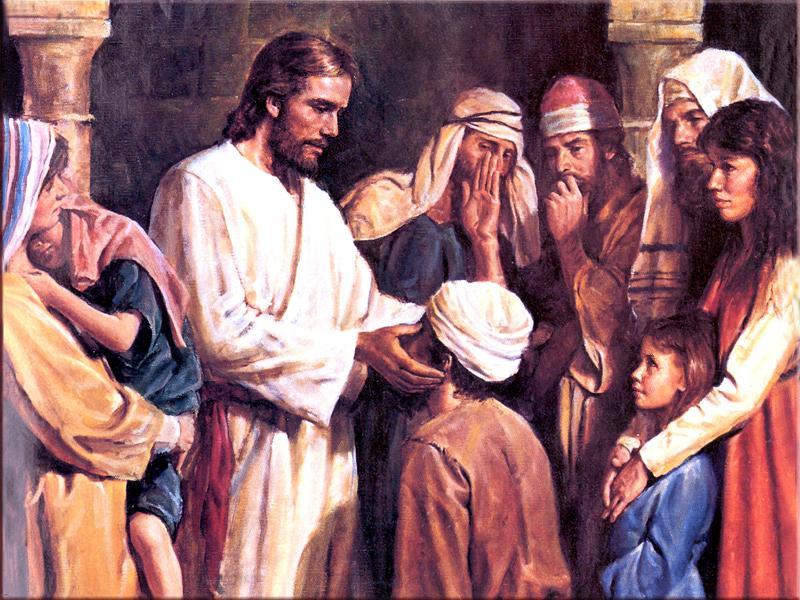
22 They came to Bethsaida, and some people brought a blind man and begged Jesus to touch him. 23 He took the blind man by the hand and led him outside the village. When he had spit on the man’s eyes and put his hands on him, Jesus asked, “Do you see anything?”
24 He looked up and said, “I see people; they look like trees walking around.”
25 Once more Jesus put his hands on the man’s eyes. Then his eyes were opened, his sight was restored, and he saw everything clearly. 26 Jesus sent him home, saying, “Don’t even go into the village.”

The disciples and Jesus continue on their journey and come to Bethsaida.  Once again a person with a physical difficulty is brought to Jesus.  It is a not so subtle reminder from Mark that people who need Jesus may need help from people who care about them to help.  Like the man born deaf and mute, the blind man's companions beg Jesus to touch their friend and heal him.

As he did with the deaf mute, Jesus removes the blind man from the crowd.  He even seems to try even harder to find privacy for the miracle when he takes the man outside of the town.  Also reminiscent of the prior miracle, Jesus spittle is instrumental in the healing.

If it were merely this, the miracle would be like any number of others in the gospel.  But Jesus looks to the man and asks him about the efficacy of the cure.  Do you see anything?

And the man reports that while he has received sight, the vision that he has is far from 20/20.  The people he sees look like trees walking around.  This is an exceedingly strange moment.  It could be that this is a continuation of the difficulty Jesus seems to be having with healing people.  Remember the complicated effort required for the deaf mute, and now it takes more than a single touch.

Or, the healing miracle may be a lesson for the disciples and for us.  They have responded to Jesus call, but still only imperfectly see what Jesus is about.  They don't understand the feedings, their hearts are hardened.  They, like the crowds, have been amazed by the displays of power, but they have not brought them faith or understanding.

So the man, who still does does not see people clearly as special creations of God but as moving objects, is once again touched by Jesus.  And with this second touch, his sight is completely healed.  

This miracle prepares us for the need for Peter who will proclaim correctly who Jesus is to be touched again to realize that he also needs to go to the cross.  It is the same second touch we need to remind us that Christianity is not merely about the joy of salvation but also the discipline of sacrifice.  
The corrective second touch of Jesus helps us to see others clearly and to realize the responsibility of our calling to them.

It is not surprising at this point that Jesus tells him to go straight home and not into the village.  What is surprising is that the man appears to do exactly what Jesus told him to do, a feat that the excitement from being healed seems to be impossible for others.  He sees clearly that Jesus' ministry is more than just power and that discipleship is following Jesus' instruction.  With clear sight, he is the first to listen.

Monday, September 24, 2012

Do You Still Not Understand?


Mark 8:1-21
During those days another large crowd gathered. Since they had nothing to eat, Jesus called his disciples to him and said, 2 I have compassion for these people; they have already been with me three days and have nothing to eat. 3 If I send them home hungry, they will collapse on the way, because some of them have come a long distance.

4 His disciples answered, But where in this remote place can anyone get enough bread to feed them?

5 How many loaves do you have? Jesus asked.

Seven, they replied.

6 He told the crowd to sit down on the ground. When he had taken the seven loaves and given thanks, he broke them and gave them to his disciples to distribute to the people, and they did so. 7 They had a few small fish as well; he gave thanks for them also and told the disciples to distribute them. 8 The people ate and were satisfied. Afterward the disciples picked up seven basketfuls of broken pieces that were left over. 9 About four thousand were present. After he had sent them away, 10 he got into the boat with his disciples and went to the region of Dalmanutha.

11 The Pharisees came and began to question Jesus. To test him, they asked him for a sign from heaven. 12 He sighed deeply and said, Why does this generation ask for a sign? Truly I tell you, no sign will be given to it. 13 Then he left them, got back into the boat and crossed to the other side.

14 The disciples had forgotten to bring bread, except for one loaf they had with them in the boat. 15 Be careful, Jesus warned them. Watch out for the yeast of the Pharisees and that of Herod.

16 They discussed this with one another and said, It is because we have no bread.

17 Aware of their discussion, Jesus asked them: Why are you talking about having no bread? Do you still not see or understand? Are your hearts hardened? 18 Do you have eyes but fail to see, and ears but fail to hear? And dont you remember? 19 When I broke the five loaves for the five thousand, how many basketfuls of pieces did you pick up?

Twelve, they replied.

20 And when I broke the seven loaves for the four thousand, how many basketfuls of pieces did you pick up?

They answered, Seven.

21 He said to them, Do you still not understand?


No, I didn't make a mistake and repost an old story.  This is in fact another mass feeding by Jesus.  And that is where the questions begin.  Why would Mark have such similar stories in his most compact of the gospels?  Surely he would have recognized the similarity between this and the feeding of chapter 6.

But there are differences, not in the story's essentials but in their details.  The plot line is the same.  A crowd is with Jesus, and lacking anything to eat, Jesus tells the disciples to feed them.  When they express exasperation, Jesus takes a small amount of food, blesses it and breaks it with enough resulting leftovers that baskets are filled.

This time it is Jesus who notices that the crowd is hungry.  He does not ask them to give the masses something to eat, but they are quick to remind Jesus that just as before they are in a remote place and there is no food in evidence.  That the disciples have doubt at this point seems incredulous, but it may be Mark showing us that the disciples have trouble even with the Syrophnecian woman and the deaf mute behind them believing that Jesus would use his power to help gentiles.

The numbers vary significantly between the stories.  The first crowd is only with him a day, while this crowd has gone three days, perhaps without eating.  In the earlier story it is five loaves and two fish given to five thousand with twelve baskets of leftovers.  Here it is seven loaves and some fish given to four thousand with only(!) seven baskets of leftovers.

Commenters have struggled mightily over the possible significance of these numbers.  The crowd in this story has been with Jesus for three days, which is the amount of time that Jesus will spend in the grave.  Is this second telling a story intended to bring in mind communion after the resurrection?  Does the hunger of the crowd mirror the hunger of the disciples waiting for Jesus to reappear?

Many have suggested that the twelve baskets of leftovers symbolize God's abundance for the people of Israel.  The five loaves and the five thousand gathered represent the five books of the Torah and thus the nation of Israel.  Seven, on the other hand is the number of completion and seventy was believed to be the number of gentile nations.  Do the seven loaves suggest that just as Jesus has first fed the Jews, now his ministry has expanded to the gentiles.  For the more acrobatic numerologists, the crowd of four thousand represents the four gospels that have become the most important scriptures of the Christian tradition.

Jesus concern about the people collapsing on their way home is another difference.  It seems to draw attention to the fact that these are people who have come a long way.  This makes them good representatives of the foreign nations.  In addition, the two previous stories have highlighted healings that are similar to those done already in Jewish territory.  It seems clear that Mark wants us to understand that Jesus ministry extended to all peoples not just the Jews of Judea.

This time when Jesus feeds the crowd, he dismisses them and gets on the boat with the disciples rather than sending them on their own.  The focus on food/Jesus continues as the disciples despair that they have not brought the leftovers with them and their hunger pangs grow.  Jesus sensing their discomfort decides to make a point and tells them to beware the yeast of the Pharisees and of Herod.  Yeast/leaven, unlike today, was considered to be unclean.  It seems another reminder of Jesus expanded mission.  He has declared all foods clean (even those with yeast) and has fed and come into close contact with Gentiles.  Did the disciples not eat at the feeding of the four thousand for fear of impurity?  That might explain why they hunger now!  What leaven/yeast uncleanness should they fear?  Not that of the gentiles, but of the religious leaders and political leaders of their own land that have tried to limit God's action to people like them.

But any abstract lesson is too much for these disciples.  They can't get past their bellies and see no meaning in what Jesus says other than that they have no bread.  They are of course wrong because Mark tells us they have one loaf.  This bread is either Jesus and his abundance or a literal loaf which if it is broken by Jesus has been shown to be enough to feed hundreds with a basket or more of leftovers.  They have no cause for worry!

And so Jesus talks them through the duplicate miracles again after asking if they have hardened hearts (which is indeed the case).  He calls on them to remember the feeding of the five thousand among the Jews.  He calls on them to remember the feeding of the four thousand among the gentiles.

And his question is the same as ours.  Do you still not understand?

Monday, September 17, 2012

A Complicated Healing


31 Then Jesus left the vicinity of Tyre and went through Sidon, down to the Sea of Galilee and into the region of the Decapolis. 32 There some people brought to him a man who was deaf and could hardly talk, and they begged Jesus to place his hand on him.
33 After he took him aside, away from the crowd, Jesus put his fingers into the man’s ears. Then he spit and touched the man’s tongue. 34 He looked up to heaven and with a deep sigh said to him, “Ephphatha!” (which means “Be opened!”). 35 At this, the man’s ears were opened, his tongue was loosened and he began to speak plainly.
36 Jesus commanded them not to tell anyone. But the more he did so, the more they kept talking about it. 37 People were overwhelmed with amazement. “He has done everything well,” they said. “He even makes the deaf hear and the mute speak.”

Jesus continues his foray into Gentile territory and enters the region of the Decapolis.  The sick and possessed and their families continue to seek him out for help.

In a scene reminiscent of the friends who bring the paralytic to Jesus in Jewish territory, a man who is deaf and unable to speak is brought before Jesus.  These people who care about the deaf and dumb man beg Jesus to touch him.  Jesus has shown that he can heal in a variety of ways--he can touch, speak and even do it remotely (the woman's daughter in the story that immediately precedes this one), but it appears that most people believe that a touch is necessary.  And yet in this case, a simple touch will not be enough.

Jesus removes the man from the crush of the crowd.  It is as if he hopes to keep what will happen here private, but as we have followed along with Jesus in Mark, we know that there is little chance that this will succeed.  And then, Jesus begins the most elaborate healing so far in the gospel.  It involves touch, saliva, prayer and words.  In previous cases, it has been just enough for Jesus to command a person to stand or for him to be unwittingly touched to bring a cure.  But now, it is almost as if the healing has become more difficult.  Too emphasize this, Mark includes the unusual detail that before Jesus speaks "Ephphatha", he lets loose a deep sigh.  Is he still tired and  unable to find rest from the swirling vortex of need that always centers around him?  Is it a hint that the focus of the gospel is about to turn away from healing?  Is he frustrated that he comes to announce the Kingdom of God, but everyone focuses on the dramatic cures?

Despite the difficulty, the healing is successful.  The man can hear and speak clearly.  The outcome is ironic because Jesus will tell him not to tell anyone, but he does exactly the opposite.  When he finally can hear, he doesn't listen.  When he is told to be silent he speaks.  The healed man entirely misuses the gifts that God has given him.  Maybe that is why it is such an effort for Jesus to heal him, he knows that the deaf and dumb man will use his new found health to serve his own purposes rather than follow God's instruction.

Jesus commands everyone to keep it quiet, but the people are disobedient.  Everyone is amazed, Mark tells us, which is a word that has occurred before.  It is a response to the power of God, but not the one God wants.  God wants obedience and worship rather than amazement.  Jesus makes the deaf hear and the mute speak but they don't listen to what he commands and they talk about what he asks them to be silent about.  The storm clouds are forming on the horizon.


Monday, September 10, 2012

Even The Dogs


24 Jesus left that place and went to the vicinity of Tyre. He entered a house and did not want anyone to know it; yet he could not keep his presence secret. 25 In fact, as soon as she heard about him, a woman whose little daughter was possessed by an impure spirit came and fell at his feet. 26 The woman was a Greek, born in Syrian Phoenicia. She begged Jesus to drive the demon out of her daughter.
27 “First let the children eat all they want,” he told her, “for it is not right to take the children’s bread and toss it to the dogs.”
28 “Lord,” she replied, “even the dogs under the table eat the children’s crumbs.”
29 Then he told her, “For such a reply, you may go; the demon has left your daughter.”
30 She went home and found her child lying on the bed, and the demon gone.

Following his conflict with the scribes and pharisees about what defiles a person, Jesus goes towards Tyre.  It is important to keep in mind that in the dispute with the leaders from Jerusalem, Jesus has essentially argued that external practices of differentiation are not the way that God judges who is pure or impure.  Jesus' position is that a pure heart not any particular set of actions is what is necessary to be undefiled in God's judgment.  This foreshadows the opening of the boundaries of God's people beyond those who rigorously adhere to Jewish tradition.

Jesus seems unable to do anything in secret in Mark.  He tries to get away with his disciples for rest only to be followed by the crowds.  He tells some of the people he heals not to tell anyone (a tactic that is largely unsuccessful).  Now he tries to go in a house surreptitiously, but once again fails at concealing his presence.  This is an interesting facet of Jesus ministry that is rarely mentioned, Jesus seems in Mark to fail at two things to this point--making his disciples understand and keeping away from the ever present mob who want Jesus to bring them healing.

The face of one from this mob is a woman whose daughter was possessed.  In the three encounters with Jesus in Mark chapter five, all include the person falling at Jesus' feet (the Gerassene Demoniac, Jairus, the woman with the issue of blood) while beseeching his intervention.  Then Mark goes away from people approaching Jesus with open hearts to his rejection at his hometown, the beheading of John and the continued hardened hearts of the disciples.  But that rejection is now left behind as this woman falls at Jesus' feet and calls to mind Jesus' acts of power in the fifth chapter.  The reader clearly expects that this encounter will end with a healing, just as the others have.

But there is a complication, the woman is not from Judea, she is a Greek from the Syrian part of Phoenicia.  Jesus has refused to allow the scribes and pharisees to draw behavioral boundaries as what delineates the people of God, and so it is no surprise when Jesus begins a conversation that will lead to a healing that mirrors that of Jairus' daughter.  While Jairus is a Jewish man who is a religious leader (and thus it is not unexpected that Jesus responds to his appeal), this is a woman who is a foreigner and lacks status of any kind.  When Jesus acts, it is a confirmation of what he has just told the scribes and pharisees.

It is not an immediate healing, however.  Jesus says that the children should be fed first because their food should not be thrown to the dogs.  Does he say this to reveal her heart to those who are listening in on the conversation?  Does he say this to make sure that those who are around do not miss that Jesus is turning things upside down?  Does he say this because it really is an open question and the woman's answer will determine what action he takes?

Her first word is Lord, which is the first time someone other than the narrator (prepare the way of the Lord) or Jesus (tell what the Lord has done for you) have used this title for Jesus.  She is the first person in all the gospel to call Jesus Lord.  This has to be significant.  When she continues that even the dogs get the crumbs, she doesn't challenge the children's right to the food, but argues that the crumbs (leftovers) are eaten by the dogs.  It calls to mind the feeding of the five thousand with all the baskets of leftovers.  Surely God's grace is so abundant that there is more than enough for the Jews to have theirs and her daughter also to be healed.

Jesus tells her that her reply--her recognition of who he is (Lord) and the recognition of the abundance of God's grace--has brought healing to her daughter.  He sends her away and she finds her daughter well.  Just as he can not keep his presence a secret, Jesus' good news overwhelms the boundaries that the Jews want to erect to keep it to themselves.

Sunday, September 2, 2012

What Defiles A Person?


The Pharisees and some of the teachers of the law who had come from Jerusalem gathered around Jesus and saw some of his disciples eating food with hands that were defiled, that is, unwashed. (The Pharisees and all the Jews do not eat unless they give their hands a ceremonial washing, holding to the tradition of the elders. When they come from the marketplace they do not eat unless they wash. And they observe many other traditions, such as the washing of cups, pitchers and kettles.)
So the Pharisees and teachers of the law asked Jesus, “Why don’t your disciples live according to the tradition of the elders instead of eating their food with defiled hands?”
He replied, “Isaiah was right when he prophesied about you hypocrites; as it is written:
“‘These people honor me with their lips,
    but their hearts are far from me.
They worship me in vain;
    their teachings are merely human rules.’
You have let go of the commands of God and are holding on to human traditions.”
And he continued, “You have a fine way of setting aside the commands of God in order to observe your own traditions! 10 For Moses said, ‘Honor your father and mother,’ and, ‘Anyone who curses their father or mother is to be put to death.’ 11 But you say that if anyone declares that what might have been used to help their father or mother is Corban (that is, devoted to God)— 12 then you no longer let them do anything for their father or mother.13 Thus you nullify the word of God by your tradition that you have handed down. And you do many things like that.”
14 Again Jesus called the crowd to him and said, “Listen to me, everyone, and understand this. 15 Nothing outside a person can defile them by going into them. Rather, it is what comes out of a person that defiles them.” [16] 
17 After he had left the crowd and entered the house, his disciples asked him about this parable. 18 “Are you so dull?”he asked. “Don’t you see that nothing that enters a person from the outside can defile them? 19 For it doesn’t go into their heart but into their stomach, and then out of the body.” (In saying this, Jesus declared all foods clean.)
20 He went on: “What comes out of a person is what defiles them. 21 For it is from within, out of a person’s heart, that evil thoughts come—sexual immorality, theft, murder, 22 adultery, greed, malice, deceit, lewdness, envy, slander, arrogance and folly. 23 All these evils come from inside and defile a person.”

The gospel of Mark turns again in Chapter 7 to the critics of Jesus.  Once again, they are not only the local religious leaders, but those from Jerusalem.  These agents from the home office remind the readers that Jesus may have friends and followers, but those in authority are strongly against him.  They "gathered around" Jesus just as students would, but their purpose is anything but learning.

They watch and record the "offenses" of Jesus and his disciples.  On this occasion, they have seen Jesus' followers eat without washing their hands prior.  This was of course not the washing for hygiene that our Mothers required, but a ritual act that was to spiritually cleanse the hands to ensure that impurity did not enter the body.  Impurity could be picked up in any number of ways--touching unclean animals, touching unclean people (any gentile for example), or touching unclean items.

This ritual cleansing is not required in the scripture, but was an additional layer of protection added by tradition.  The thought was that by keeping the stricter traditions that were added to the law, the law was kept safe.  In addition to the rules regarding ritual washing of the hands there were a large number of others including those mentioned by Mark of washing cups, pitchers and kettles.

The Pharisees and the teachers of the law directly challenge Jesus about his disciples failure to keep the tradition of the elders.  But rather than engage them in a rabbinic argument from tradition, Jesus instead goes straight to the authoritative prophet (Isaiah).  He calls those who challenge him hypocrites, which is the Greek word for "stage actors."  In their challenge and actions they are merely playing a role for the world to see rather than demonstrating their true nature.  As the prophet has described they say the right things with the wrong hearts.  Their worship is invalid and they teach human rules rather than God's rules.

This seems to always be an issue for religious authorities and churches.  It is easy to turn God into yet another rationale for requiring behavior that benefits those in power.  Jesus refuses to allow this misappropriation of God's authority.

He further continues to turn the tables by pointing out the way that the Jewish officials have allowed exceptions to God's law while refusing to bend their own traditions.  He refers particularly to one of the ten commandments.  God requires that children honor their parents.  This was more than an instruction to young children to eat their vegetables.  It was in the time before welfare a commandment to ensure that aging parents who could no longer work were provided for--a sort of social security.

But the religious types had figured a way around this seemingly straightforward command.  By declaring their wealth korban--or set aside for God--the children were able to live on their resources even as they denied the responsibilities of their parents because their estate was  dedicated to a higher purpose.

Jesus points out that not only have the authorities accused his disciples not of breaking God's law but human tradition.  They themselves erected traditions that broke God's law.

He then turns the focus back to the question of being defiled or impure.  The traditions teach that what comes into a person from the outside makes a person unclean on the inside.  But Jesus reminds them that everything that comes into the body goes from the mouth to the stomach and then is excreted, not to the heart.  Mark feels the need to emphasize that when Jesus said this he was declaring all foods clean.  Making this assertion seems to be directed towards Jews who read the gospel and practiced strict food guidelines.  It may have seemed ironic to those who read because here Jesus clearly institutes a new teaching that modifies not tradition, but the teaching of the Torah.

Jesus has an entirely definition of impurity.  Defilement is what comes out of your mouth not what goes in it.  A person's heart is revealed by their actions and words.  The Pharisees and teachers of the law reveal the corruption of their hearts as they act as if they are committed to God, but their words reveal that their commitments are really towards their own benefit.