Wednesday, March 13, 2013

Jesus Crucified


16 The soldiers led Jesus away into the palace (that is, the Praetorium) and called together the whole company of soldiers. 17 They put a purple robe on him, then twisted together a crown of thorns and set it on him. 18 And they began to call out to him, “Hail, king of the Jews!” 19 Again and again they struck him on the head with a staff and spit on him. Falling on their knees, they paid homage to him. 20 And when they had mocked him, they took off the purple robe and put his own clothes on him. Then they led him out to crucify him.
21 A certain man from Cyrene, Simon, the father of Alexander and Rufus, was passing by on his way in from the country, and they forced him to carry the cross. 22 They brought Jesus to the place called Golgotha (which means “the place of the skull”). 23 Then they offered him wine mixed with myrrh, but he did not take it. 24 And they crucified him. Dividing up his clothes, they cast lots to see what each would get.
25 It was nine in the morning when they crucified him. 26 The written notice of the charge against him read: the king of the jews.
27 They crucified two rebels with him, one on his right and one on his left. 29 Those who passed by hurled insults at him, shaking their heads, and saying, “So! You who are going to destroy the temple and build it in three days,30 come down from the cross and save yourself!” 31 In the same way the chief priests and the teachers of the law mocked him among themselves. “He saved others,” they said, “but he can’t save himself! 32 Let this Messiah, this king of Israel, come down now from the cross, that we may see and believe.” Those crucified with him also heaped insults on him.

Following the judgment of Pilate, Jesus is brought to the soldier's barracks.  There before them all, he is tortured.  One needs only think back to Abu Ghraib to be reminded how the culture of the professional soldier can easily lead to horrific abuse of those they identify as their enemy when in captivity.

They begin by dressing Jesus in a parody of regal attire.  A purple robe denotes royalty and the crown of thorns not only mimics a royal crown, but also has thorns which push into the head of the one wearing it.  Like Pilate, their concern is that Jesus has some claim to political governance.  They look at the broken bleeding man before them and kneel in feigned obeisance.  Hail, King of the Jews.

This coronation functions not only as entertainment for the soldiers, but also as an ironic comment by Mark.  They are truly crowning the king, but it is a king unlike any they have seen.  Jesus' suffering does not disqualify him, but instead qualifies him to lay claim to God's messiah.

Jesus appears unable to carry the cross bar for himself and a random man from the crowd is conscripted to help him.  Simon is from Cyrene which makes him a North African.  So, the man who helps Jesus is dark-skinned.  We are told of his sons Rufus and Alexander as if we should know who they are.  We don't, but the implication is that Simon and his family became parts of the church.

The text's words to describe the incident of the cross are similar to Mark's earlier admonition from Jesus to take up his cross and follow.  Unlike the other disciples, Simon is doing what Jesus requires.

Jesus is brought to the place of public execution which is outside the city limits.  There he is offered wine with myrrh as a sedative which he refuses.  Although Mark has used fully one third of the gospel on Jesus' passion, his description of the crucifixion is remarkable for its brevity and lack of detail.  Once again, just as the soldiers have stripped Jesus of his purple cloak, Jesus garments are removed and become the spoils of a game of chance.

Above Jesus head is written the charge against him.  "King of the Jews" is the way that Pilate and the soldiers have addressed him.  Of course, the term Messiah or Christ used by the Jewish religious leaders does have this political implication as well.  The irony is that the plaque is right even as the claim is rejected both by the Jewish religious leaders and the Romans.
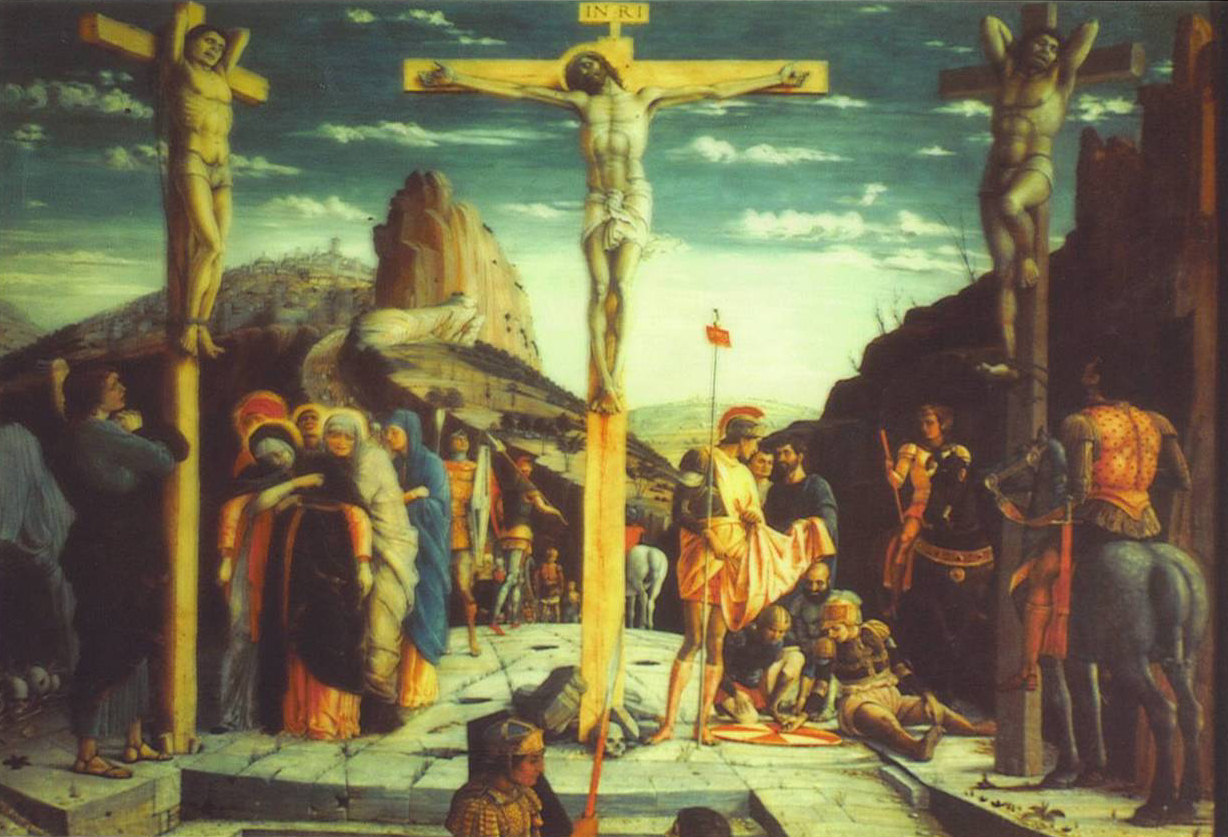
Joining Jesus are two criminals on either side.  Mark reports no conversation between Jesus and the thieves.  The disciples have asked to be at Jesus right and left hand.  Now that Jesus is crucified they are nowhere to be found.  On his right and left are criminals.

The crowd that is gathered mocks Jesus.  "If you are so great, save yourself."  It is easy to remember that Jesus told his disciples that whoever saves their life will lose it.  Jesus choose to lose his life so that he may return to life and offer life to others.

The religious leaders on hand suggest that if he is the Messiah, the king of Israel, (using both the religious and political titles) to show them something and they will believe.  When Jesus first calls the disciples, he tells them to "come and see".  Jesus ministry of miracles is bracketed by the healing of two blind men.  They have seen all this, but they will not believe, and it takes little imagination to believe that even if they were to see Jesus leave the cross that they would still not believe.

The final indignity is that even the ones who are crucified with him join in the mockery.  Jesus on the cross is surrounded by people, but is utterly alone.


Monday, March 4, 2013

Trial By Pilate


Very early in the morning, the chief priests, with the elders, the teachers of the law and the whole Sanhedrin,made their plans. So they bound Jesus, led him away and handed him over to Pilate.
“Are you the king of the Jews?” asked Pilate.
“You have said so,” Jesus replied.
The chief priests accused him of many things. So again Pilate asked him, “Aren’t you going to answer? See how many things they are accusing you of.”
But Jesus still made no reply, and Pilate was amazed.
Now it was the custom at the festival to release a prisoner whom the people requested. A man called Barabbas was in prison with the insurrectionists who had committed murder in the uprising. The crowd came up and asked Pilate to do for them what he usually did.
“Do you want me to release to you the king of the Jews?” asked Pilate, 10 knowing it was out of self-interest that the chief priests had handed Jesus over to him. 11 But the chief priests stirred up the crowd to have Pilate release Barabbas instead.
12 “What shall I do, then, with the one you call the king of the Jews?” Pilate asked them.
13 “Crucify him!” they shouted.
14 “Why? What crime has he committed?” asked Pilate.
But they shouted all the louder, “Crucify him!”
15 Wanting to satisfy the crowd, Pilate released Barabbas to them. He had Jesus flogged, and handed him over to be crucified.

From the night time informal court, Jesus is brought to Pilate.  The Jewish leaders on their own could not carry out capital punishment.  It was a level of punishment reserved for the Romans.  They have decided that Jesus blasphemy is worthy of death, but while his "I am" statement would have been offensive to them, it would have been merely words to the Roman occupiers.  They have to decide what they can accuse Jesus of that will be significant enough for the death penalty.

They appear from Pilate's question to have decided to paint Jesus as an insurrectionist against Rome.  While claims to divinity wouldn't have worried Pilate much, claims to political power would have been taken very seriously.  "Are you the king?" Pilate asks.  Jesus terse reply seems to indicate that he is acknowledging the charge while not confirming or denying it.

And so the trial begins.  The charges are numerous, but Jesus remains silent. Mark clearly places the trial in parallel to the scene in the high priest's courtyard.  Jesus is falsely accused and speaks only in direct answer to a question from the presiding official.  

The charade of the charges is clear to Pilate, and he is amazed that Jesus does not offer a defense.  So Pilate is left to make the judgement.  He hopes that by invoking the tradition of clemency for one prisoner, he will avoid having to condemn a man he knows to be innocent.  So likely in providing the choice of prisoners he seeks to make it a stark contrast and easy decision.  Do you want the King of the Jews to be free or a murderer.  He may or may not know that Barabbas is Hebrew for "son of the father".  So in a way, he offers them the choice between the son of the father who brings life and the son of the father who brings death.

And the mob incited by the chief priests choose death.  They cry for Barabbas' release and Jesus death.  Crucifixion appears to have been the Roman's preferred execution as it served as a public and continuing warning to others.

Sadly Pilate is the kind of leader who leads from behind.  The crowd is in a furor and he doesn't really care all that much and so Jesus is handed back to the Jews so that they can crucify him.

Monday, February 25, 2013

I Don't Know What You Are Talking About

66 While Peter was below in the courtyard, one of the servant girls of the high priest came by. 67 When she saw Peter warming himself, she looked closely at him.
“You also were with that Nazarene, Jesus,” she said.
68 But he denied it. “I don’t know or understand what you’re talking about,” he said, and went out into the entryway.
69 When the servant girl saw him there, she said again to those standing around, “This fellow is one of them.” 70 Again he denied it.
After a little while, those standing near said to Peter, “Surely you are one of them, for you are a Galilean.”
71 He began to call down curses, and he swore to them, “I don’t know this man you’re talking about.”
72 Immediately the rooster crowed the second time. Then Peter remembered the word Jesus had spoken to him:“Before the rooster crows twice you will disown me three times.” And he broke down and wept.

As Jesus is agreeing with the High Priest about his messiahship, Peter has retained his physical distance.  He is approached by a slave girl of the high priest.  It is helpful to keep in mind that the ear was taken off of the last servant of the high priest in the story.  She eyes Peter up and down and then pronounces that she has seen him with Jesus the Nazarene.

An odd word in the accusation is the "also."  It seems unnecessary as there is no else around who has been identified as being with Jesus.  Is there some other encounter that has been left on the floor of the editor?  We do not know.

Peter acts as if she is form another planet.  He has no idea what she is talking about, he tells her.  The encounter completed he goes to the entryway, further distancing himself physically from Jesus.

The servant girls comes upon him again and tells those who are standing around that Peter is one of them (again, "them" seems a bit odd if slightly more understandable than the also).  A second time Peter denies.

And then the crowd says that he must be one of "them" because he is clearly from the backwater of Galilee (did his accent or clothing give him away?)  Peter denies, again, by calling God's judgment on them for lying.  In salty words, he tells them that he doesn't even know the man they are talking about, clearly avoiding invoking Jesus name.

It is a crescendo of denial.  Peter first denies that he understands what he is being asked.  Peter's second denial is that he is one of "them."  His third denial is that he does not even know Jesus.  Peter tries initially to redirect, then denies association with the group and finally with Jesus himself.

There is a clear mirror here between these incidents and Jesus' trial in the previous verses.  Jesus is innocent but the witnesses lie and he is convicted.  Peter is guilty and the witnesses tell the truth and he goes free.

In the larger context of Christian persecution that Mark's original readers were in, this scene would resonate with their experiences of fellow Christians who under persecution lied rather than faced execution.  They knew the fear that came with being identified as one of "them."

The rooster crows the second time (Mark does not record the first).  And in that moment, Peter has clarity that in seeking to save his life he has lost it and until he is ready to lose it he will not be able to save it.  His salty tears follow his salty curses and he realizes that he has brought heaven's judgement on himself.

Monday, February 18, 2013

The Arrest and Trial


43 Just as he was speaking, Judas, one of the Twelve, appeared. With him was a crowd armed with swords and clubs, sent from the chief priests, the teachers of the law, and the elders.
44 Now the betrayer had arranged a signal with them: “The one I kiss is the man; arrest him and lead him away under guard.” 45 Going at once to Jesus, Judas said, “Rabbi!” and kissed him. 46 The men seized Jesus and arrested him.47 Then one of those standing near drew his sword and struck the servant of the high priest, cutting off his ear.
48 “Am I leading a rebellion,” said Jesus, “that you have come out with swords and clubs to capture me? 49 Every day I was with you, teaching in the temple courts, and you did not arrest me. But the Scriptures must be fulfilled.” 50 Then everyone deserted him and fled.
51 A young man, wearing nothing but a linen garment, was following Jesus. When they seized him, 52 he fled naked, leaving his garment behind.
53 They took Jesus to the high priest, and all the chief priests, the elders and the teachers of the law came together.54 Peter followed him at a distance, right into the courtyard of the high priest. There he sat with the guards and warmed himself at the fire.
55 The chief priests and the whole Sanhedrin were looking for evidence against Jesus so that they could put him to death, but they did not find any. 56 Many testified falsely against him, but their statements did not agree.
57 Then some stood up and gave this false testimony against him: 58 “We heard him say, ‘I will destroy this temple made with human hands and in three days will build another, not made with hands.’” 59 Yet even then their testimony did not agree.
60 Then the high priest stood up before them and asked Jesus, “Are you not going to answer? What is this testimony that these men are bringing against you?” 61 But Jesus remained silent and gave no answer.
Again the high priest asked him, “Are you the Messiah, the Son of the Blessed One?”
62 “I am,” said Jesus. “And you will see the Son of Man sitting at the right hand of the Mighty One and coming on the clouds of heaven.”
63 The high priest tore his clothes. “Why do we need any more witnesses?” he asked. 64 “You have heard the blasphemy. What do you think?”
They all condemned him as worthy of death. 65 Then some began to spit at him; they blindfolded him, struck him with their fists, and said, “Prophesy!” And the guards took him and beat him.

As Jesus predicted the arrival of his betrayer, amidst the sleepy betraying disciples, Judas appears with a torch wielding angry mob sent by the leaders of all the factions of Jewish power.  It seems a rather heavy handed approach for a person whose only violent act was turning over some tables in the temple court.  Why they feel swords and clubs are necessary for a simple apprehension is difficult to discern.  They have waited until Jesus was out of the temple to apprehend him due to their fear of what the people might do.

In a seemingly unnecessary gesture that stands in stark contrast to the violence inherent in the approach of the crowd, Judas chooses a kiss to be his marking of Jesus as the appropriate focus of their action.  The simple kiss will be transformed from an act of intimacy to a sign of betrayal.  Judas does not hesitate, walks straight to Jesus and kisses him.  The posse doesn't hesitate either and Jesus is quickly arrested.

Someone standing near, identified in other gospels, but here anonymous, sees the violence and responds with violence drawing a sword and cutting off the servant of the high priest's ear.  The details of the event make it important.  Leviticus says that if the high priest or his servants is disfigured that they are no longer qualified to be high priest.  Other gospel writers use this story for different purposes, but Mark does not have Jesus condemn the action nor heal the wound.  He does criticize the  crowd that has come for him for choosing to do so in the dark, but he goes with them to fulfill the scriptures.  Everyone deserts Jesus leaving him abandoned, betrayed and alone in the control of those who wish him ill.

Then we come to perhaps the strangest and most disjointed incident in Mark. A young man avoids apprehension by running away naked when the crowd attempts to capture him.  Who is he?  Why is the garment important?  The first kiss to be printed with a printing press is followed shortly by the first streaker, and no one knows why.  One intriguing suggestion, is that he is meant to remind the reader of Joseph fleeing from the false charges of Potiphar's wife.  Another school of thought is that this is the same young man who will appear at the tomb later to announce the resurrection.  Some even attempt to suggest that this is the author's signature of a sort, putting himself into the gospel.  2000 years of speculation have led to no definitive answer.

Yet another interwoven scene is introduced when Mark tells us that as Jesus is brought to stand before the Jewish powers that be, Peter follows at a discrete distance.  But when he arrives in the courtyard, he chooses to sit with the guards rather than to sit with Jesus.  We are reminded of Jesus prediction that all will fall away and in the dark of the courtyard, Peter is fulfilling it.

With Jesus in their custody, the Sanhedrin begins to try to build a case against him.  They are shown to be ineffective in this effort as they can not find agreeing testimony.  Finally they make a charge that Jesus has said that he will tear down the temple and rebuild another in three days not made by hands.  Mark never records Jesus saying this, although it does seem a combination of the little apocalypse and Jesus resurrection prediction.  It is a sort of false, but true accusation.  Those making the charges are right even though they don't understand why.

Mark makes it clear that either the leaders believe that Jesus has predicted and may be planning the destruction of the temple or believe that if he hasn't that this charge is the most heinous and incendiary one possible.  Why do they want to kill Jesus?  Jesus is the enemy because he threatens the building that is central to their economy and power.

Finally the voice of the high priest (who you'll remember has just been disqualified) gains the floor.  "Is this true?" he asks?  But Jesus remains silent.  It is only when he asks if Jesus is the Messiah that an answer comes. Jesus answer comes as no surprise since Mark has said in sentence one that Jesus is the Christ.  When Jesus says "I am" it is both an answer and a declaration of divinity as God's revealed name to the Hebrew people was "I am."  In Mark 1:1 Jesus is identified not only as the Messiah, but also as the son of God.  Here however, Jesus asserts his dual nature as "I am" but also son of Man who will descend from the clouds in glory.

This is enough for the high priest, they had been going for a charge of insurrection, but now they had an even greater offense blasphemy.  The Sanhedrin quickly condemns him to death, an ironic sentence as they are unable to carry it out with out Roman permission who would not have seen this charge (unlike insurrection) as a capital offense.  They will need to come up with something else to put him to death, but they are inflamed now and blood lust has seized them.

Jesus is spit upon.  He is blindfolded (an odd detail) and asked to identify who has hit him.  It is almost as if the anonymity provided by Jesus covered eyes gives them permission to act with violence.  The scene is disturbing on many levels.  The educated,elevated Sanhedrin reduced to the thuggery of hitting a blindfolded and bound man.  Even those who are "guards" of Jesus join in on the explosion of emotion.  


Tuesday, February 12, 2013

The Flesh Is Weak


27 “You will all fall away,” Jesus told them, “for it is written:
“‘I will strike the shepherd,
    and the sheep will be scattered.’
28 But after I have risen, I will go ahead of you into Galilee.”
29 Peter declared, “Even if all fall away, I will not.”
30 “Truly I tell you,” Jesus answered, “today—yes, tonight—before the rooster crows twice you yourself will disown me three times.”
31 But Peter insisted emphatically, “Even if I have to die with you, I will never disown you.” And all the others said the same.
32 They went to a place called Gethsemane, and Jesus said to his disciples, “Sit here while I pray.” 33 He took Peter, James and John along with him, and he began to be deeply distressed and troubled. 34 “My soul is overwhelmed with sorrow to the point of death,” he said to them. “Stay here and keep watch.”
35 Going a little farther, he fell to the ground and prayed that if possible the hour might pass from him. 36 “Abba,Father,” he said, “everything is possible for you. Take this cup from me. Yet not what I will, but what you will.”
37 Then he returned to his disciples and found them sleeping. “Simon,” he said to Peter, “are you asleep? Couldn’t you keep watch for one hour? 38 Watch and pray so that you will not fall into temptation. The spirit is willing, but the flesh is weak.”
39 Once more he went away and prayed the same thing. 40 When he came back, he again found them sleeping, because their eyes were heavy. They did not know what to say to him.
41 Returning the third time, he said to them, “Are you still sleeping and resting? Enough! The hour has come. Look, the Son of Man is delivered into the hands of sinners. 42 Rise! Let us go! Here comes my betrayer!”

After leaving the supper, Jesus tells the disciples that not just one of them will betray him but that all of them will.  He quotes a text from Zecheriah to make his point.  It is a prophecy of great sadness, but this does not end his speech.  Now Jesus says, after I have risen which is a promise, so at the same time there is fear the reality of hope is uncovered.  Jesus tells the disciples that he will precede them.

Of course, Peter can not leave well enough alone.  He assumes that it is possible (probable?) that every one else will not be up to the task, but he is different than they are, cut from a better cloth.

Jesus rather than praising his bravado instead tells Peter that despite his claim he will deny him three times before the rooster crows twice.  But Peter will not accept it and again affirms his loyalty even to death.  The other disciples not eager to be topped all now proclaim their loyalty.

And so they come to Gethsemane and Jesus asks the disciples to wait while he prays.  He takes Peter, James and John with him (Andrew is suddenly a no show) and he begins to be distressed.  Almost certainly, this unsettling is about the path he sees in front of him.  It could also be that he looks around at Peter, James and John and realizes that his disciples are in denial and unprepared to face what is on its way.

Jesus leaves the three remaining disciples in order to go and pray on his own. He reveals to them his sadness and tells them to keep watch.  He goes further and falls to the ground and prays.  He uses the familiar term "Abba" which is the equivalent to our "Daddy" as he addresses God.  He asks for the cup to be removed from him.  This is the third reference to the cup.  He has asked his inner circle of disciples if they are able to drink the cup that he will. He offers the cup of his blood.  And now he asks for the cup to be removed.  It is almost certainly a symbol of his sacrifice.  But the hymn they likely sang at the conclusion of the passover meal references the "cup of salvation".  Jesus knows the hard path of sacrifice/salvation and pleads that if there were another way it would be taken.  But in the end, Jesus chooses not the easier way but God's will.

It is a high point in devotion and obedience, immediately mirrored in the negative by Jesus' return to his disciples who have fallen asleep.  Jesus has offered his very life in God's service while the disciples are overcome by their own need for comfort.

Simon, Jesus says.  It is the first time since Jesus renamed him Peter that he calls him by his given name.  It is as if his failure has made him no longer the "rock" upon whom the church will be built.  He is merely Simon who struggles to keep his eyes open when the fate of the universe is being decided.

Two more times, Jesus will return and each time he finds the disciples sleeping.  They have proven to be inadequate companions in his hour of need.  And now Judas is approaching and betrayal is at hand.  When the hour of sacrifice comes, the crowds that surrounded him early in the gospel have long since disappeared.  When the hour of sacrifice comes, the disciples who have sworn their loyalty are asleep.  When the hour of sacrifice comes, Jesus is profoundly alone.

Monday, February 4, 2013

The Lord's Supper


12 On the first day of the Festival of Unleavened Bread, when it was customary to sacrifice the Passover lamb, Jesus’ disciples asked him, “Where do you want us to go and make preparations for you to eat the Passover?”
13 So he sent two of his disciples, telling them, “Go into the city, and a man carrying a jar of water will meet you. Follow him. 14 Say to the owner of the house he enters, ‘The Teacher asks: Where is my guest room, where I may eat the Passover with my disciples?’ 15 He will show you a large room upstairs, furnished and ready. Make preparations for us there.”
16 The disciples left, went into the city and found things just as Jesus had told them. So they prepared the Passover.
17 When evening came, Jesus arrived with the Twelve. 18 While they were reclining at the table eating, he said, “Truly I tell you, one of you will betray me—one who is eating with me.”
19 They were saddened, and one by one they said to him, “Surely you don’t mean me?”
20 “It is one of the Twelve,” he replied, “one who dips bread into the bowl with me. 21 The Son of Man will go just as it is written about him. But woe to that man who betrays the Son of Man! It would be better for him if he had not been born.”
22 While they were eating, Jesus took bread, and when he had given thanks, he broke it and gave it to his disciples, saying, “Take it; this is my body.”
23 Then he took a cup, and when he had given thanks, he gave it to them, and they all drank from it.
24 “This is my blood of the covenant, which is poured out for many,” he said to them. 25 “Truly I tell you, I will not drink again from the fruit of the vine until that day when I drink it new in the kingdom of God.”
26 When they had sung a hymn, they went out to the Mount of Olives.

Mark wants us to understand Jesus' death through the lens of the Passover.  During this feast, the Jews recreated the story of their deliverance from Egypt.  During the final plague, the one that convinces Pharaoh to free the Hebrew slaves, the Israelites are told to put the blood of a slain lamb on their doorpost.  This mark tells the angel of death to "passover" their homes as the first born sons of Egypt are slain.

Mark's story will also have the death of a lamb, the lamb of God.  His blood will be a mark and a promise that the faithful will be delivered from slavery to mindless religious ritual to the freedom of a new life with God.  Interestingly, Mark connects the story also with the death of the first born.  God identifies with the Egyptians who lose their children not due to their own sin, but because of the systems of sins and government that sit above their lives.

The story begins by sounding remarkably similar to the passage describing the  acquisition of the colt for Jesus to ride into Jerusalem.  "Where will we eat the Passover?" the disciples ask.  They continue to be observant Jews even as Jesus has discredited the temple and its duplicitous and voracious activity.  We often fail to see the essential Jewishness of Jesus, but this passage reminds us that the roots of the Christian tradition are deeply sunk in the loam of Judaism.  Jesus tells the disciples where to go and what to say to acquire the room for a Passover meal (a meal that is typically observed by families--signifying perhaps that the disciples and Jesus have formed a new family).  The room will be in such and such a place and here is what to say Jesus tells them.  Despite the crowds in Jerusalem, (miraculously?) there is a place for them to gather and share supper.  Mark seems in this and the passage about the colt to want to make it clear that Jesus is in control and that God has already prepared his path.

When the disciples sit down with Jesus for the meal, it starts with the recognition that the betrayer is with them.  Did Jesus know that Judas had already agreed to sell him to the religious leaders?  Was Judas without a choice in the matter?  Or if he had not played the role would one of the other disciples?  These are interesting questions, but the most important one to me is:  what does it mean that Jesus serves Judas even as he has made plans to betray him?  What does this act say about God?  It is of course service to the betrayer with a warning, that turning against Christ results in judgment.

The formula that Jesus uses to serve the bread and cup are strongly reminiscent of the passover meal, but Jesus reinterprets it.  The bread becomes his body and the cup his blood.  The bread is broken in prophetic action predicting his death.  The cup is the blood of the new covenant poured out for many.  Like the lamb's blood that marked the door post, the cup marks believers and is a sign of a new promise between God and humanity.

Jesus pronounces that he will not drink again until the new Kingdom of God is established.  It is like the "little apocalypse" in chapter 13, a warning and a promise.  It is a statement that holds in tension the death/resurrection of Jesus.

They cannot stay at the meal celebrating their freedom forever, so they sing a hymn and go out to the Mount of Olives, where Jesus freedom will be taken away.


Monday, January 28, 2013

In Memory Of Her

14 Now the Passover and the Festival of Unleavened Bread were only two days away, and the chief priests and the teachers of the law were scheming to arrest Jesus secretly and kill him. “But not during the festival,” they said, “or the people may riot.”
While he was in Bethany, reclining at the table in the home of Simon the Leper, a woman came with an alabaster jar of very expensive perfume, made of pure nard. She broke the jar and poured the perfume on his head.
Some of those present were saying indignantly to one another, “Why this waste of perfume? It could have been sold for more than a year’s wages and the money given to the poor.” And they rebuked her harshly.
“Leave her alone,” said Jesus. “Why are you bothering her? She has done a beautiful thing to me. The poor you will always have with you, and you can help them any time you want.  But you will not always have me. She did what she could. She poured perfume on my body beforehand to prepare for my burial.  Truly I tell you, wherever the gospel is preached throughout the world, what she has done will also be told, in memory of her.”
10 Then Judas Iscariot, one of the Twelve, went to the chief priests to betray Jesus to them.  11 They were delighted to hear this and promised to give him money. So he watched for an opportunity to hand him over.

The "Little Apocalypse" is followed by a quick transition back to the simpler narrative focused on Jesus' journey to the cross.  The time and setting are established as two days from Passover.  The chief priests and the teachers of the law, who should be involving themselves in religious preparation for this holy time are instead contemplating the arrest and killing of Jesus (which clearly is breaking one of the ten commandments).  The Passover is the time for celebrating when God spared the first born sons of Israel, and now the teachers of the law are planning the death of a first born son of Israel. The sham of their authority is revealed by their decision to wait until after the festival to avoid any unpleasantries with the populace.  And yet, later we will find that Jesus is orchestrating the timeline of events and even their wish to wait until after the festival is thwarted.

Outside of Jerusalem, Jesus reclines at the table.  This accurately reflects the way that meals were eaten in the day.  Rather than tall tables and chairs, meals were taken at low tables from the floor.  Not surprisingly, none of the "respectable" folks are hosting Jesus but instead a man we hear of only here. Simon the Leper.  It reflects a sad tendency of humanity through time of reducing people to their illness.  And this pernicious illness would have disqualified Simon from much of ordinary  life.  Even if he had been healed or gotten better, he would always be Simon the Leper and warily scanned at each meeting to see if the illness had begun to return.  The people who would gather at his table were almost certainly those who had no place else to go.

The meal is interrupted by a woman with a jar.  She would in most settings have been an unwelcome guest.  A woman had no status in society and a woman who travelled by herself would have been viewed with a powerful suspicion.  Her touch would render any man potentially unclean.

Perhaps social conventions were not as powerful in the home of Simon the Leper.  Perhaps that is why Jesus chose to take his meal there.  But this unnamed woman is still able to offend the sensibilities of those who are gathered.  She has brought with her an alabaster vase filled with expensive perfume that she pours on Jesus feet.

A little historical context is valuable here.  The vase was likely the funeral perfume that was poured on a body to keep its odor down in an age prior to embalming.  Its expense made it prohibitive for many to own.  It would have cost the equivalent of a year's wages.  To own such a jar was to provide funeral insurance for yourself.  It meant your family would not have additional expenses at your burial.

That the woman pours it on Jesus' feet seems to make two important points.  First, Jesus is on his way to his death.  This woman is preparing Jesus for his burial.  The disciples are unable to comprehend Jesus' prediction of his death, but this woman understands Jesus' path.  More importantly, this woman pours her security at Jesus' feet as if she no longer needs it.  It is as if that in the presence of Jesus she is no longer afraid of death.

Some at the dinner are aghast at her action.  Wouldn't a better tribute to Jesus have been to sell the perfume and use the money to feed the poor.  How they feel qualified to judge someone else for a gift they have made rather than to judge themselves for gifts they have not given is an open question.  Her action is reminiscent of that of the widow at the temple, whose gift Jesus does not criticize for being misdirected.  Rather, he understands that the value is in the act of giving.

Jesus is clear in his condemnation.  The poor will always be with you, he says.  This has been taken by some as an excuse not to assist those in need.  What good can one really do, if the poor are always there.  But the passage seems to say something entirely different.  Jesus tells the disciples that they are responsible for the good they can do in each moment.  The woman is praised for doing the right action at the right time.  But, when the poor are in front of you, help them. 

This woman's act of faithfulness will be preached in her memory, Jesus tells them.  She will be remembered, even though her name is not.  This passage points to those nameless saints who have gone before us who with acts of devotion made it possible for us to hear and believe in Jesus.

But, the mood turns dark when another gift is made.  Judas disappears into the dark to betray Jesus.  Unlike the woman, his name is not forgotten, but his action is not one of love and adoration.  His gift is not for Jesus, it is Jesus he offers.  While Jesus offers life, the religious leaders offer money.  Judas was probably one of the voices counseling against waste and now he is insuring himself as he thinks best against the future even as he betrays God's future.