Wednesday, January 23, 2013

The End of Time


13 As Jesus was leaving the temple, one of his disciples said to him, “Look, Teacher! What massive stones! What magnificent buildings!”
“Do you see all these great buildings?” replied Jesus. “Not one stone here will be left on another; every one will be thrown down.”
As Jesus was sitting on the Mount of Olives opposite the temple, Peter, James, John and Andrew asked him privately, “Tell us, when will these things happen? And what will be the sign that they are all about to be fulfilled?”
Jesus said to them: “Watch out that no one deceives you. Many will come in my name, claiming, ‘I am he,’ and will deceive many. When you hear of wars and rumors of wars, do not be alarmed. Such things must happen, but the end is still to come. Nation will rise against nation, and kingdom against kingdom. There will be earthquakes in various places, and famines. These are the beginning of birth pains.
“You must be on your guard. You will be handed over to the local councils and flogged in the synagogues. On account of me you will stand before governors and kings as witnesses to them. 10 And the gospel must first be preached to all nations. 11 Whenever you are arrested and brought to trial, do not worry beforehand about what to say. Just say whatever is given you at the time, for it is not you speaking, but the Holy Spirit.
12 “Brother will betray brother to death, and a father his child. Children will rebel against their parents and have them put to death. 13 Everyone will hate you because of me, but the one who stands firm to the end will be saved.
14 “When you see ‘the abomination that causes desolation’ standing where it does not belong—let the reader understand—then let those who are in Judea flee to the mountains. 15 Let no one on the housetop go down or enter the house to take anything out. 16 Let no one in the field go back to get their cloak. 17 How dreadful it will be in those days for pregnant women and nursing mothers! 18 Pray that this will not take place in winter, 19 because those will be days of distress unequaled from the beginning, when God created the world, until now—and never to be equaled again.
20 “If the Lord had not cut short those days, no one would survive. But for the sake of the elect, whom he has chosen, he has shortened them. 21 At that time if anyone says to you, ‘Look, here is the Messiah!’ or, ‘Look, there he is!’ do not believe it. 22 For false messiahs and false prophets will appear and perform signs and wonders to deceive, if possible, even the elect. 23 So be on your guard; I have told you everything ahead of time.
24 “But in those days, following that distress,
“‘the sun will be darkened,
    and the moon will not give its light;
25 the stars will fall from the sky,
    and the heavenly bodies will be shaken.’
26 “At that time people will see the Son of Man coming in clouds with great power and glory. 27 And he will send his angels and gather his elect from the four winds, from the ends of the earth to the ends of the heavens.
28 “Now learn this lesson from the fig tree: As soon as its twigs get tender and its leaves come out, you know that summer is near. 29 Even so, when you see these things happening, you know that it is near, right at the door.30 Truly I tell you, this generation will certainly not pass away until all these things have happened. 31 Heaven and earth will pass away, but my words will never pass away.
32 “But about that day or hour no one knows, not even the angels in heaven, nor the Son, but only the Father. 33 Be on guard! Be alert! You do not know when that time will come. 34 It’s like a man going away: He leaves his house and puts his servants in charge, each with their assigned task, and tells the one at the door to keep watch.
35 “Therefore keep watch because you do not know when the owner of the house will come back—whether in the evening, or at midnight, or when the rooster crows, or at dawn. 36 If he comes suddenly, do not let him find you sleeping. 37 What I say to you, I say to everyone: ‘Watch!’”

It is hard to miss Mark 13.  It sticks out like a dandelion in a welll tended yard.  And because it is so odd, rarely is it the focus of attention in the church.  It is simply too dense, too layered, too metaphorical, too different compared to the rest of the gospel.  Scholars refer to the chapter as the "little apocalypse", but they too struggle to understand its place.

It is a long speech, continuing longer than any other of Jesus' teachings in the gospel.  It seems to string together a variety of topics together, with an emphasis on the struggle the disciples will face in Jesus' absence and the coming end of the world.  So far in Mark, Jesus has very much been about the present and the few times he has looked forward it has been only to the cross.  Now Jesus' focus is beyond the cross and to the effect that following will have on the apostles.

This longer look begins when Jesus leaves the temple.  On their way out, the disciples are overwhelmed by the majesty of the complex.  While the chapter may depict a significant shift in Jesus, the disciples are still dull witted and slow.  Jesus has just shown that the temple has become a fraud where God is no longer the focus.  But the disciples are bewitched by the soaring structure. So, Jesus once again has to burst their bubble--the stones will not stand one upon the other.  Buildings aren't eternal and to be worshipped, only God is.

Now Jesus sits opposite the temple, a physical placement that reflects the conflict between the Christ and the establishment.  He is with Peter, James, John and Andrew.  They are an important group because they are the first four disciples named in the gospel.  Oddly, Andrew has begun to sink to the background as he is listed as the second one to be called and now is the fourth to be named.

When will the stones be torn down, Jesus?  The disciples are still focused on the building and not on the Messiah or their own needs.  Like many people they revel in the judgment of others blind to their own needs.

First Jesus warns them that there have always been, will always be, folks who will declare that the sky is falling.  There will be lots of events that can be made into portents of the end, but Jesus warns against reckless calls of the apocalypse.  These things are not signs of the end, but signs of the beginning.  What Jesus wants the focus to be on is not the destruction of the old way, but the birthing of a new way.

But this coming Kingdom of God that will replace the old order is not primarily a struggle of the cosmos or the nations, it is a change that will effect those who follow Jesus.  During this time, believers will be under persecution and hardship.  They will be placed on trial and will witness to their faith.  They are to rely on the Holy Spirit to give them the words when they are asked.

The time of testing will result in the tearing apart of family.  The strongest of human bonds are not enough to protect those who believe and speak the truth to the powerful.  At the end/birth of the new age, everyone will hate those who have the power of belief.

Jesus tells them that the sign of the end will be the presence of the abomination of desolation where it does not belong.  This is a reference to a passage in Daniel that is believed to refer to the erection of a statue of Zeus in the temple during the 2nd century B.C.E.  Jesus reminds the disciples of the incursion of the political sphere into the religious world.  Does Jesus have in mind the presence of the money changers and the infiltration of the Roman empire in the life of the Jewish people?

Truly odd is the appeal to the "reader" which must be an inclusion by Mark, trying to keep the warning of Jesus from being seen as a particular word to the current disciples and instead as a universal appeal.  Following Jesus will not be easy.  This warning to hope that it doesn't happen in winter and the reminders of human suffering sound little like the call to discipleship offered by the modern church.

But, these terrors will be shortened by the return of the Son of Man.  Not shown through small marvels and wonders, but by His coming in clouds with angels. There will be no ambiguity about Christ's identity or return.
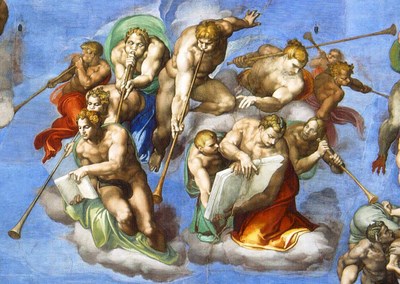
Jesus again invokes a fig tree, this time not as a thing to curse but as a sign of hope.  When Jesus finds no figs, it points to the lack of fruit in the temple.  The leaves are false signs.  But now, the disciples are told to look to the fig trees and their leaves as signs that the new kingdom is near.

Some scholars have suggested that Jesus prediction about this generation not passing away is a sign that he was mistaken about when the end would come.  But the generic "this generation" may refer to the family of faith that will continue through time until the end.

The exact day will be a mystery, so believers must always be alert.  When someone leaves you in charge of a house you stay vigilant until their return.  So the disciples need to always be alert, because no matter how bad things may be, at some point, God will make things right.

All sorts of frightening and twisted theological speculation has taken place over the analysis and over-reading of this text.  Put simply and perhaps most profitably, Jesus is saying that being a Christian is never easy, but that God is always working towards delivering believers.


Monday, January 14, 2013

The Widow's Mite


35 While Jesus was teaching in the temple courts, he asked, “Why do the teachers of the law say that the Messiah is the son of David? 36 David himself, speaking by the Holy Spirit, declared:
“‘The Lord said to my Lord:
    “Sit at my right hand
until I put your enemies
    under your feet.”’
37 David himself calls him ‘Lord.’ How then can he be his son?”
The large crowd listened to him with delight.
38 As he taught, Jesus said, “Watch out for the teachers of the law. They like to walk around in flowing robes and be greeted with respect in the marketplaces, 39 and have the most important seats in the synagogues and the places of honor at banquets. 40 They devour widows’ houses and for a show make lengthy prayers. These men will be punished most severely.”
41 Jesus sat down opposite the place where the offerings were put and watched the crowd putting their money into the temple treasury. Many rich people threw in large amounts. 42 But a poor widow came and put in two very small copper coins, worth only a few cents.
43 Calling his disciples to him, Jesus said, “Truly I tell you, this poor widow has put more into the treasury than all the others. 44 They all gave out of their wealth; but she, out of her poverty, put in everything—all she had to live on.”

Jesus continues to make himself a presence in the temple, but now as with the question of whose authority John baptizes with, he presents his own conundrum to the people gathered there.  "Why do the teachers of the law say Christ is the Son of David?"

The question brings to mind the encounter with the blind man Bartimaeus who recognizes Jesus for as Son of David.  He is the only one in the gospel to do so and is for him a confession of Jesus as Messiah.

Jesus however challenges this title by quoting scripture.  From the Psalm, he reminds that David wrote of God telling the Messiah that his enemies will be placed under his feet.  When he does he refers to the Christ as Lord which would not be the way a father refers to a son.  If this is the case then clearly the Messiah is not a son of David.

This seems like a strange bit of overreaching instruction, but the people are delighted by it.  It is also interesting that the other synoptic gospels go to great lengths through genealogy to establish Jesus as the son of David.  Mark seems unconcerned to go to these lengths.  In fact, Jesus is not subordinate to anyone but God, not even David.

As he delights the crowd by poking holes in the orthodoxy of the teachers of the law, he goes from a criticism of what they believe to a criticism of how they act.  Because they don't hold the proper faith, they don't/can't live the proper life.  They are more concerned with establishing their own importance and authority than they are with leading people into a relationship with God.  Among their faults are wearing ostentatious clothing, desiring respect for their position rather than their person, living off the charity of the poor, and using language to obfuscate their lack of spiritual devotion.  Their punishment for these misplaced priorities will be of the most severe nature.

Jesus then goes to watch the offerings being brought to the temple.  The temple offering boxes had a horn that amplified the sound of gifts being placed within the treasury.  The more coins deposited, the louder and longer the sound, leaving no doubt as to who were the big givers.  Large contributions were a way to bring honor to one's self and one's family.

But Jesus pays little attention to these who give large gifts because they will not miss them.  He instead focuses on a widow who puts two small copper coins in the till.  I suspect that she tried to go unnoticed on her silent effort hoping to draw no attention to herself.

Unseen by everyone else, Jesus notices her and sees the perfect example of what he has just been teaching about.  He tells the disciples that giving out of her poverty she has given more than those who have made the horn ring.

This is perhaps the most essential teaching on stewardship that Jesus makes.   First, he proposes a progressive view that equates the value of the gift not in its face value, but in the level of sacrifice it requires.  Also, even though he has condemned the temple's offering system, he praises the widow because she gives faithfully even though the system has been unfaithful to her.  She is judged not on who she gives to, but on what she gives.  Her accountability is for her response to God, not the response of others.


Tuesday, January 8, 2013

The Great Commandment


28 One of the teachers of the law came and heard them debating. Noticing that Jesus had given them a good answer, he asked him, “Of all the commandments, which is the most important?”
29 “The most important one,” answered Jesus, “is this: ‘Hear, O Israel: The Lord our God, the Lord is one. 30 Love the Lord your God with all your heart and with all your soul and with all your mind and with all your strength.’ 31 The second is this: ‘Love your neighbor as yourself.’ There is no commandment greater than these.”
32 “Well said, teacher,” the man replied. “You are right in saying that God is one and there is no other but him.  33 To love him with all your heart, with all your understanding and with all your strength, and to love your neighbor as yourself is more important than all burnt offerings and sacrifices.”
34 When Jesus saw that he had answered wisely, he said to him, “You are not far from the kingdom of God.” And from then on no one dared ask him any more questions.

The culminating dispute with Jesus in this section of Mark is also the most well known and also perhaps the most surprising.  This time it is not Jesus delivering the definitive final statement as not the closing frame of the scene.

The previous debates all began when people were sent to start a dispute with Jesus.  In this case, the public disputes are overheard and a teacher of the law believes that Jesus has answered what were the koan like questions of the day with skill.  So he asks him his own question, which seems from his heart rather than from some agenda.  Over the years, Jewish religious types had determined that there were a large number of commandments from God.  Some of these were profound and well known to us (e.g the ten commandments) others governed all sorts of personal and corporate behavior.

So faced with a raft of commandments, the teacher of the law asks Jesus which one is primary.  Jesus answers with what is known as the Shema from Deuteronomy 6:4.  Hear, O Israel, The Lord our God is one, a phrase that is repeated in Jewish prayers.  It reminds the people that the God they serve is unlike the gods of the surrounding people.  They are to commit the entirety of their beings to love of Yahweh.  This is not a command that is given in private to individuals but a challenge to the community.

But Jesus will not stop with merely a command about a corporate attitude to the divine, but attaches a second which also is about love, but focuses on others and self.  The essential command then is to love a trinity of God, others and self.

In all of the previous disputation stories, this is where the period would be.  Some observation about the amazement of the hearers might follow.  But the teacher of the law speaks again, not to ask another question, but to essentially restate and emphasize what Jesus has already said.  He observes that Jesus is right in his observation and that the commands that Jesus has focused upon are more important than the sacrificial system.  This forms an appropriate conclusion to this section that begins with Jesus turning over the temple money changers tables and is followed by a series of questions about God's commands that are designed to trip Jesus up.

Jesus recognizes the teacher's wisdom, which is apparently to embrace what Jesus is saying, and tells him that he is not far from the Kingdom of God.  This is almost certainly a positive appraisal, although being not far is certainly not the same as being within.  What does the teacher of the law have yet to do to get in?  Does he need to live the truth, or does he need to recognize that Jesus is not "rabbi" as he has addressed him, but Christ, the Son of God as Mark begins his gospel.  Does he not yet understand that Jesus is not offering simply a lesson but a way of life?  In some ways the encounter is reminiscent of another encounter that Jesus has where commandments are invoked.  The rich ruler has said that he has kept all the requirements and Mark tells us that Jesus loves him.  Unfortunately when asked to give up his wealth, he can not continue to follow.  In this case, we don't know whether this teacher of the law turns away or enters.  Like the ending of the gospel in a few chapters, Mark leaves us with a cliffhanger.

Mark concludes the section by observing that no one dares to ask him a question.  Jesus has faced the trap questions about authority, Caesar, resurrection, and the fundamental commandment.  This part of the passion week is now over, and Jesus is one step closer to the weight of the cross.

Wednesday, January 2, 2013

Whose Wife Will She Be?


18 Then the Sadducees, who say there is no resurrection, came to him with a question. 19 “Teacher,” they said, “Moses wrote for us that if a man’s brother dies and leaves a wife but no children, the man must marry the widow and raise up offspring for his brother. 20 Now there were seven brothers. The first one married and died without leaving any children.21 The second one married the widow, but he also died, leaving no child. It was the same with the third. 22 In fact, none of the seven left any children. Last of all, the woman died too. 23 At the resurrection whose wife will she be, since the seven were married to her?”
24 Jesus replied, “Are you not in error because you do not know the Scriptures or the power of God? 25 When the dead rise, they will neither marry nor be given in marriage; they will be like the angels in heaven. 26 Now about the dead rising—have you not read in the Book of Moses, in the account of the burning bush, how God said to him, ‘I am the God of Abraham, the God of Isaac, and the God of Jacob’? 27 He is not the God of the dead, but of the living. You are badly mistaken!”

The interrogation of Jesus by the religious authorities continues unabated.  For us many of these questions that are posed to Jesus seem as pointless as the scholastic dispute over how many angels can dance on the head of a pen.  The questions were, however, for the day relevant.  We may ask, why in the world is this important, but 2,000 years from now someone will look back at the controversy between praise choruses and hymns and wonder much the same.

This time, the Pharisees and Herodians are replaced by the Sadducees as Jesus interlocutors.  The Sadducees were the equivalent of today’s fundamentalists.  While we tend to portray the Pharisees as legalists, they were actually the progressives of the day.  The Sadducees refused to accept any religious authority other than the Torah (the first five books of our bible).  If a religious idea was not contained within these scrolls it was not to be entertained.  So while the Pharisees believed in an afterlife, the Sadducees rejected the notion as a modern intrusion.

This all makes their question even more absurd.  When they ask Jesus a question about resurrection, the correct answer as far as they are concerned is that the premise of the question is flawed.  Any answer Jesus gives other than to deny resurrection will show him to be a fraud in their eyes.  But for the crowd around Jesus who would have been more in the line with the blue collar Pharisees than the privileged Sadducees, to deny the resurrection would be proof that Jesus was not an authentic teacher from God.

The convoluted hypothetical which they pose to Jesus must have been a favorite from their rabbis who used it to show the absurdity of resurrection.  A woman outlives seven brothers who because of filial obligation each marry her in turn.  Moses provided for this to ensure that a widow had a social safety net.  But when she dies, whose wife will she be?

Jesus refuses to play their game and rather than answer their question attacks their premise.  He accuses them, the ones who pride themselves on keeping the integrity of scripture of not knowing the scripture or God’s power.  I cannot imagine anything that Jesus might have said that would have been more inflammatory.

Resurrection is more than human life recreated in a new place.  It is instead existence in the presence of God where human traditions become unimportant.  The Sadducees have made it their life to enforce human traditions as the path to God, but now Jesus says that human tradition is worthless in the presence of God.

Finally, Jesus goes to the Torah and rabbinic argument to disprove the position of the Sadducees on resurrection.  If the scripture says God in the present tense is the God of Abraham, Isaac and Jacob, then they must still exist.  Otherwise, the text would say God was their God.  While this would have been an acceptable form of rabbinic argument in that day, it seems a bit labored to us.  The key is that Jesus uses their own accepted way of proving things to prove them wrong.

Most importantly, in his conclusion, Jesus reminds them that God is the God of the living and not the dead.  God is about the present and if we are to be with God, we can do so only by living in the present with God.

What Is Caesar's


13 Later they sent some of the Pharisees and Herodians to Jesus to catch him in his words. 14 They came to him and said, “Teacher, we know that you are a man of integrity. You aren’t swayed by others, because you pay no attention to who they are; but you teach the way of God in accordance with the truth. Is it right to pay the imperial tax to Caesar or not? 15 Should we pay or shouldn’t we?”

But Jesus knew their hypocrisy. “Why are you trying to trap me?” he asked. “Bring me a denarius and let me look at it.” 16 They brought the coin, and he asked them, “Whose image is this? And whose inscription?”

“Caesar’s,” they replied.

17 Then Jesus said to them, “Give back to Caesar what is Caesar’s and to God what is God’s.”

And they were amazed at him.

Yet again, the religious and secular authorities attempt to get Jesus to incriminate himself with one party or another. This time it is the Pharisees and Herodians who though sharing some similar interests also had striking differences. The Pharisees although exceptionally religiously devoted were the more moderate wing of Judaism. The Herodians were a political group allied with King Herod, who although a Jew was not particularly religious. The family had paid for the temple renovation not as an act of piety but as a way to cement their control of the people. The Herodians were also very much sympathizers with the Roman occupation as Herod drew all of his authority from the Caesar.

The biggest area of conflict between the two groups would have been over the question of taxation. The Herodians would have supported the Roman taxes as their payment insured Herod's continued rule. The Pharisees, on the other hand, would have been more likely to side with the people and see foreign taxes as something to be done eliminated.

They approach Jesus with a real question, but with false motives. Their first words are the sort of flattery that is spoken while their forked tongues hiss between licked lips. They "know" that Jesus is a person with integrity and will answer their question honestly because he follows God and not other people. They ask him a deceptively simple yes/no question.

But, when the two groups combine to ask Jesus is it lawful to pay taxes to Caesar, they each have a different "correct" answer in mind. If Jesus supports the tax, the Herodians will be happy, but the crowd will turn against him and Jesus will lose his protection from the religious authorities. If Jesus opposes the tax, the Pharisees will applaud, but the machinery of the government will be set against him for speaking treason. Jesus' answer is unimportant because his answer is wrong either way.

The pharisees and Herodians claim to know Jesus (when it is clear they don't), but Jesus knows them and that their question is one of hypocrisy. So rather than a yes or no, he asks them to bring him a denarius, a Roman coins to examine. 

When it is placed in his hand, he asks the assembled his own question. Whose image and inscription are on the coin? They reply that it is Caesar. Much like the trick question he has been asked, Jesus ensnares those in the crowd with his seemingly simple query. First, he condemns the people who are carrying the coins. The face stamped on the coin is a graven image and thus in violation of one of the commandments. The inscription indicated the deity of the Caesar again in violation of the decalogue. Whoever even carried one of these coins was in violation of the Jewish faith, and the ability to produce one when asked for clearly implies that some (and probably most) of the crowd carried them.

But Jesus continues to argue that whatever bears Caesar's mark must belong to Caesar and therefore should be given to him. Which seems at first to indicate that Jesus is in favor of the empire's tax. However, Jesus concludes his statement and to God that which is God's.

An important note is that when God creates humanity in Genesis it is done in God's image. So when Jesus asks what image is on the coin, he calls to mind that all people are made in God's image. If the presence of the image indicates ownership then clearly if every person bears God's image then every person should be rendered unto God. Which leaves us with a very different question that remains unasked in the air, Does anything belong to Caesar when everything belongs to God.

There is as there has been before amazement at Jesus' words. This is clearly as it has alway been different from belief. The Pharisees and Herodians are just as hard hearted as ever, but they can't believe their cunning plan has failed and the knot they hoped to tie Jesus up in is instead holding them too tight to wriggle out of.

Monday, December 17, 2012

Parable Of The Vineyard


12:1 Jesus then began to speak to them in parables: “A man planted a vineyard.  He put a wall around it, dug a pit for the winepress and built a watchtower. Then he rented the vineyard to some farmers and moved to another place. At harvest time he sent a servant to the tenants to collect from them some of the fruit of the vineyard. But they seized him, beat him and sent him away empty-handed. Then he sent another servant to them; they struck this man on the head and treated him shamefully. He sent still another, and that one they killed. He sent many others; some of them they beat, others they killed.
“He had one left to send, a son, whom he loved. He sent him last of all, saying, ‘They will respect my son.’
“But the tenants said to one another, ‘This is the heir. Come, let’s kill him, and the inheritance will be ours.’ So they took him and killed him, and threw him out of the vineyard.
“What then will the owner of the vineyard do? He will come and kill those tenants and give the vineyard to others.10 Haven’t you read this passage of Scripture:
“‘The stone the builders rejected
    has become the cornerstone;
11 the Lord has done this,
    and it is marvelous in our eyes’?”
12 Then the chief priests, the teachers of the law and the elders looked for a way to arrest him because they knew he had spoken the parable against them. But they were afraid of the crowd; so they left him and went away.


Mark observes that Jesus begins to teach in parables.  Parabolic teaching has not been a centerpiece of Mark so far.  While Luke and Matthew abound with parables, Mark seems to primarily orient his gospel around the parable of the soils.  Certainly, there are very few parables with extended narratives.  It seems that this extended parable may serve the same function as the one about the types of ground.  Just as the parable of the soils is told to interpret Jesus ministry, the parable that will follow is told to interpret the passion narrative that will follow.


An unidentified man plants a vineyard.  This is an effort with a large up front effort for a later pay-off.  Not only must the grapevines mature, the vineyard also is at risk from nature and from mischief.  The vineyard owner knowing this builds a wall around his project.  He digs out a pit where the juice of the grapes will be pressed to make wine.  Finally, he puts up a tower so that someone can be constantly on the lookout.


For whatever reason, the owner decides to go away.  Having already invested so much, it is no surprise that he finds farmers to care for his ground.  When the time for harvest arrives, he sends a servant to collect some of the fruit.  Perhaps the workers wages are paid with the fruit that is to be left behind.


The workers, however, are unwilling to part with any of the fruit of their labor.  Rather than give the servant what he has asked for they seize him, beat him and send him away with nothing.  Just verses earlier, the Jewish leaders have been asking about authority.  Clearly these vineyard workers reject the authority of the master and believe they are the ones who have authority.  They take the masters proxy and treat him like a thief who has come to take what does not belong to him.


The master behaves with an odd forbearance that strains credulity.  Another servant is sent and rejected with an emphasis that he is struck on the head.  This calls to mind the alternate meaning of the word for "head" that can also mean source.  It is clear that these tenants are striking out against not the servant but the authority that he represents.


The farmers continue to escalate against the series of messengers as they move from assault to murder.  The owner's patience is inexplicable in any human terms.  Why does he continue to send anyone other than the police as the workers essentially claim ownership over the vineyard?  Is he fair to the servants he continues to send?  Is he asking for volunteers?


The land holder continues with his unreasonable approach by finally deciding to send his son.  Why does he think that the treatment will be any different?  He convinces himself that this is a good idea by believing that the renters will respond to clear authority.


They do not.  In fact, they see the arrival of the son as their golden opportunity.  Their irrational thinking leads them to believe that they will become the vineyard's rightful owners.  Do they believe that the owner has died and the son is claiming his inheritance?  If that is the case, killing him will revert the land to those who have been present on it.  


Whatever the case, the son is killed and his body is not treated with any respect and is thrown outside the wall of the vineyard.  The rhetorical question is asked about what the vineyard owner will do.  Finally, Jesus tells us, the owner will act, kill the tenants and get some new ones.  The very action that the renters believe will make the property theirs is the one that removes it from their control and brings their demise.


This calls to mind part of Psalm 118 to Jesus who suggests that these tenants have rejected the stone that will be used by God to be the capstone to hold the span that crosses the gap between God and humanity.  Like those who have been entrusted with the vineyard, the Jewish religious leaders have shamefully treated all of God's true messengers and soon will kill even God's son in their attempt to wrest control of the world from God.


The religious leaders seem to miss most of what God is revealing, but they have 20/20 vision when it comes to the people.  They do understand that Jesus speaks the parable about them, but their fear of the crowd leaves them fuming and planning in private about how they will get Jesus.

Monday, December 10, 2012

Have Faith


12 The next day as they were leaving Bethany, Jesus was hungry. 13 Seeing in the distance a fig tree in leaf, he went to find out if it had any fruit. When he reached it, he found nothing but leaves, because it was not the season for figs.  14 Then he said to the tree, “May no one ever eat fruit from you again.” And his disciples heard him say it.
15 On reaching Jerusalem, Jesus entered the temple courts and began driving out those who were buying and selling there. He overturned the tables of the money changers and the benches of those selling doves, 16 and would not allow anyone to carry merchandise through the temple courts. 17 And as he taught them, he said, “Is it not written: ‘My house will be called a house of prayer for all nations’? But you have made it ‘a den of robbers.’”
18 The chief priests and the teachers of the law heard this and began looking for a way to kill him, for they feared him, because the whole crowd was amazed at his teaching.
19 When evening came, Jesus and his disciples went out of the city.
20 In the morning, as they went along, they saw the fig tree withered from the roots. 21 Peter remembered and said to Jesus, “Rabbi, look! The fig tree you cursed has withered!”
22 “Have faith in God,” Jesus answered. 23 “Truly I tell you, if anyone says to this mountain, ‘Go, throw yourself into the sea,’ and does not doubt in their heart but believes that what they say will happen, it will be done for them.

Following his brief sojourn in Jerusalem the night before, Jesus returns ready for action.  Mark tells us that on the way he was hungry.  This is the first time that the gospel has described Jesus with this human need.  The final action taken at Jesus' crucifixion in Mark is the crowd giving him a sponge with liquid.  In a way, these bookmark the story of the corruption of Jewish piety that provides neither spiritual food nor drink to those who hunger and thirst for righteousness.

Jesus sees a fig tree in the distance.  It is green and leafy as the growing season would be just beginning in Israel in April.  Not able to discern if their are early figs present because of the leaves, Jesus is disappointed upon reaching it to find that there are no fruit present.  This was not the season for fruit, Mark tells us, so we wonder why Jesus expected any.  Does Mark want us to recall the struggles that Jesus has faced so far with the leaders of Israel in the gospel who have all of the appearance of devotion but no fruit of faith?  Jesus pronounces that no will eat of this particular fig tree and is overheard by his disciples.  This is the first record of a curse from Jesus.  Although it may be that like the demons he has driven out before, it is a miracle that is destructive to the oppressor and freeing for the ones who suffer.

Jesus enters the Temple and drives out those who are buying and selling.  The Temple courts were open to both Gentiles and Jews.  The courts had become a marketplace where people did the business that kept the temple running.  The buying and selling likely consisted of priest-approved animals for sacrifice.  The priests had to approve an animal to be sacrificed as blemish free, so a thriving business consisted of priests (for a fee) approving animals (whether they were blemish free or not) and then being sold to religious pilgrims at a premium.

He also overturns the money changers tables.  These tables were set up for convenience so that people could bring Roman money (which was used everywhere) for Temple money which was only valid in the Temple.  A thriving Temple business grew based on selling the Temple money which was given to the Temple treasury and then sold back to other pilgrims the next day in a perpetual cycle.

Jesus anger would be very understandable.  What often is misread here is that Jesus criticism of them as robbers refers to what is going on at the tables.  But Jesus calls the Temple a "den" which is where the robber's live and count their ill-gotten gains, not where they practice their thievery.  The Temple has become the place where people go to get forgiveness for their sins so they can go out again and sin some more.  It is a tree without the fruit (of repentance).

Which is the point Mark drives home as Jesus leaves the Temple.  Those he has exposed as hypocrites are understandably angry and anxious to get their revenge, so the plotting begins.  They are thieves planning their next crime.  But, we are told they fear public action because the populace at large seems to agree with Jesus diagnosis of what ails the Temple.

On their way back into town the next day, the disciples and Jesus pass the fig tree from the previous day.  It is Peter who notices its withered condition that goes all the way to its root.

Jesus tells the disciples that with belief anything can be accomplished even throwing mountains in the sea.  There are no conditions except certain total faith, which is in its own way a significant condition.  True faith aligns itself with God's will.  Jesus is not saying that perfect belief will put a Ferrari in your driveway, but that perfect faith will remove all the obstacles that keep a person from bearing fruit even when it is not the season for figs.